
10 VMware to AWS Migration Specialists: What Sets Them Apart in 2026
Executive Summary
- VMware renewals, licensing changes, and expiring support contracts have turned VMware exits into time-bound infrastructure decisions with real operational risk.
- The strongest VMware migration outcomes come from specialists who plan around renewal timing, dependency risk, cutover ownership, and post-go-live stabilization.
- The best VMware to AWS migration specialists are NOVA, Rackspace Technology, IBM Consulting, Accenture, and several others, based on how they handle exit planning, renewal pressure, cutover execution, and post-migration ownership.
- The key tradeoff across providers is whether they reduce lock-in by moving natively on AWS or carry VMware forward under a different cost structure.
***
NOVA helps you migrate to AWS with assessment-led planning, hands-on execution, and stabilization that holds up under production pressure. Contact us to start with a VMware exit assessment to set the path.
VMware renewals, licensing shifts, and data center exits are making VMware to AWS migration a time-bound decision. The work spans contract timing that drives sequencing, hidden dependencies that raise cutover risk, and clear ownership during go-live that determines whether issues are resolved quickly or drag on.
That reality puts pressure on partner choice.
So, in this article, we'll help you compare specialists on how they handle VMware exits and migration execution. You’ll see who plans for cutover, rollback, and stabilization (and who doesn’t).
What Is VMware to AWS Migration (and Why It Matters Now)?
VMware to AWS migration means moving VMware workloads into AWS services. This includes dependencies on virtual machine compute, networking, and storage.
This happens most frequently through rehosting on Amazon EC2, followed by migration and modernization, where the operational or cost case is clear.
The work is less about copying VMs and more about preserving application behavior while changing the platform underneath. This makes dependency mapping, cutover planning, and rollback design non-negotiable.
Remember: Timing matters because, right now, VMware Cloud on AWS is no longer resold by AWS, and this introduces new licensing and renewal dynamics (it is still available via Broadcom / VMware).
In response, AWS introduced Amazon Elastic VMware Service (EVS), generally available on August 5, 2025, and has since expanded to 13 regions including South America (São Paulo) as a VMware Cloud Foundation option running inside AWS.
Warning: EVS moves the infrastructure bill to AWS but does not reduce VMware licensing dependency or Broadcom exposure. The platform constraints and subscription terms travel with the workload. That shift explains why many teams are reassessing their direction. Industry leaders are seeing the same pressure surface across enterprise environments.
“A huge portion of VMware customers are actively looking at alternatives. I think it’s 73 percent of VMware customers are pursuing alternatives at this point in time.” - Randall Hunt, CTO of Caylent.
At this stage, the question is no longer whether to plan a proper migration to AWS, but which path reduces risk without creating a new form of lock-in.
Why Choose a VMware to AWS Migration Specialist?
A VMware to AWS migration specialist is necessary because work under contract and cost pressure breaks down when it’s handled like a generic migration process. In practice, renewal timing, hidden dependencies inside VMware environments, and unclear ownership during go-live introduce cutover risk that general providers tend to miss.
With that context in mind, here are the areas where specialist execution matters most:
- Licensing and vendor-change risk planning: Broadcom shifts can compress timelines and force early decisions. A specialist sequences work around renewals so the move to AWS Cloud does not lock in unfavorable terms or trigger support gaps.
- Dependency mapping and cutover engineering: Many VMware virtual environments contain silent app-to-app calls, batch jobs, and legacy mounts. These are mapped before lift-and-shift, so cutover windows and rollback paths are clearly defined.
- Landing zone and security baselines: Identity, networking, segmentation, guardrails, and governance are established first. This includes controls aligned with AWS Identity and Access Management (IAM) to ensure production traffic flows into a governed environment.
- Target architecture choice: EVS versus AWS-native is a long-term call. So, a specialist explains tradeoffs clearly instead of defaulting to a VMware carryover.
- Migration automation: AWS services and tooling, such as AWS Transform for VMware where applicable, reduce manual effort during discovery and execution. This lowers configuration errors and shortens cutover windows.
Each of these choices directly affects downtime, cost exposure, and post-cutover stability.
Pro tip: If VMware renewals or partner changes are driving your timeline, read our guide on the risk of VMware's VCSP program collapse for enterprises to understand where execution and support gaps usually appear before migration starts.
Best VMware to AWS Migration Specialists
The best VMware to AWS migration specialists are NOVA, Rackspace Technology, IBM Consulting, Accenture, Persistent Systems, and several others, based on how they handle exit planning, renewal pressure, cutover execution, and post-migration ownership. NOVA is the only specialist in this review that also addresses hardware cost relief through a buyout and leaseback program, removing a common financial barrier to migration.
1. NOVA
NOVA supports VMware exits by taking ownership of planning, execution, and stabilization rather than stopping at recommendations. The work starts with VMware exit assessments that surface renewal timing, dependency risk, and sequencing constraints.
Execution leverages AWS Transform and other ISV migration tools for automated discovery and wave planning, alongside NOVA's own assessment methodology.
Then it moves into an AWS-native migration roadmap that avoids carrying VMware forward. From there, AWS-native replatforming covers EC2, RDS or Aurora, and container platforms such as ECS or EKS. This is all based on what the application actually needs to run predictably after cutover.
During the transition window, Bridge Support keeps existing VMware environments stable while migration work progresses. This reduces pressure from expiring contracts or support gaps.
In parallel, Asset Relief allows hardware buyout and leaseback, so capital does not stay tied to infrastructure scheduled for retirement. After cutover, stabilization and ongoing optimization stay in scope. The focus remains on incident handling, cost controls, and steady operations rather than recurring review calls.
In our Brightfield engagement, NOVA used an upcoming license renewal as the forcing function to plan and execute an AWS-native migration on a compressed timeline. The result was a move away from licensed infrastructure toward managed services that improved deployment reliability and reduced long-term operating costs.
Pros:
- Clear AWS-native exit approach without long-term VMware carryover.
- Bridge Support and Asset Relief offered as defined delivery pillars.
- Experience with retail and CPG stacks, including Shopify and MuleSoft integrations.
Cons:
- Not intended for organizations planning to keep VMware long-term on AWS, though it can support EVS conversations.
- Project scope assumes hands-on execution.
Website: NOVA
Pricing: Custom quote.
2. Rackspace Technology
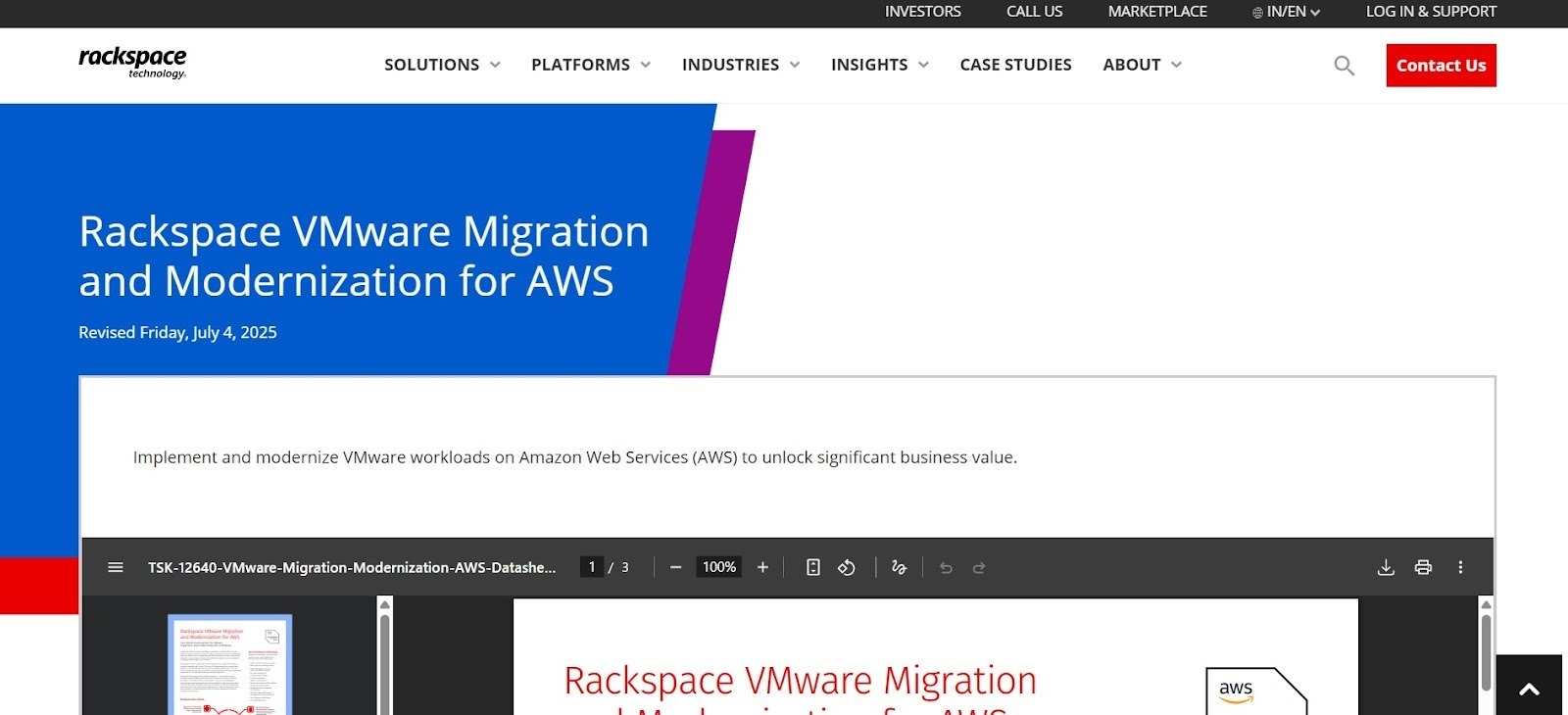
Rackspace Technology supports AWS migration programs that include VMware environments. It has a delivery model built around assessment, landing zone setup, execution, and Day-2 operations.
The approach usually centers on migration paths that retain VMware tooling through AWS, which is supported by automation and 24×7 operations. Programs such as Rapid Migration bundle discovery, dependency analysis, and cutover execution into a defined scope. That helps align timelines and ownership during go-live.
For example, in a large AWS migration for a travel ecommerce platform, Rackspace migrated hundreds of servers in controlled waves, reduced database latency, and applied post-cutover right-sizing to address migration costs.
Pros:
- Delivery model with defined scope and ownership.
- Per-VM pricing options for predictable budgeting.
- Operational coverage as a long-term managed service provider.
Cons:
- Heavier focus on lift-and-shift migration than AWS-native refactoring.
- Service model aligns best with mid-to-large enterprises.
- Less opinionated guidance on exiting VMware entirely.
Website: Rackspace Technology
Pricing: Custom quote.
3. IBM Consulting
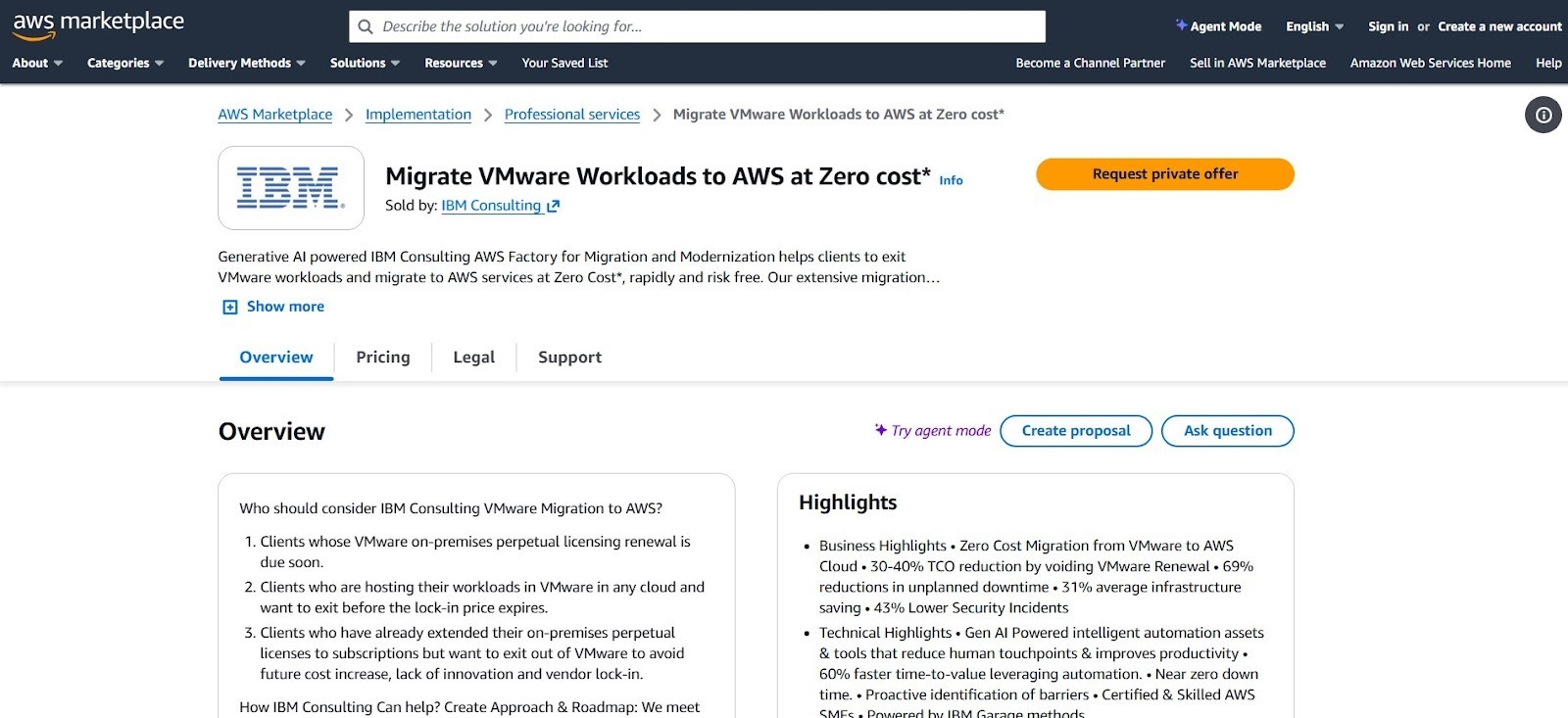
IBM Consulting supports AWS migration programs that include clearly defined pathways for VMware migration.
There's also published guidance on moving VMware workloads into AWS and a dedicated AWS Marketplace listing focused on that transition. The approach spans assessment, dependency mapping, landing zone setup, and execution, then continues into stabilization and operating model changes after cutover.
Delivery typically follows a migration factory model. This helps coordinate sequencing, automation, and ownership across large portfolios (it doesn’t treat each application in isolation).
IBM has documented work with global manufacturing firms moving hundreds of VMware-hosted applications into AWS services. The company used staged cutovers and post-move cost controls to keep production stable while shifting data center load away from VMware.
Pros:
- Clear migration pathways published for VMware environments.
- Factory-style execution suited for large, multi-application moves.
- Marketplace-backed programs aligned with AWS incentives.
Cons:
- Engagement model fits enterprise scale more than small estates.
- Modernization paths often introduce additional IBM platforms.
- Less flexibility for narrowly scoped exits.
Website: IBM Consulting
Pricing: Custom quote.
4. Accenture
Accenture delivers AWS migration programs that include VMware environments through the AWS Marketplace offering built on AWS Transform for VMware. The delivery is augmented with Accenture automation to accelerate discovery and execution.
The service focuses on accelerating discovery, dependency mapping, and wave planning, then executing controlled cutovers into an AWS target state. This approach fits large estates where speed and scale matter, especially when timelines are fixed by contract or data center exit deadlines.
From an execution standpoint, the model relies on automation to map VMware environments to AWS, visualize network and security dependencies, and produce a defined “to-be” architecture before migration begins.
In documented projects, Accenture has migrated hundreds of servers in phased waves. This coordinated application owners and infrastructure teams to keep production stable while shifting servers to AWS.
Pros:
- Automation to accelerate large migration projects.
- Network and security modeling before cutover.
- Global delivery capacity for complex enterprise programs.
Cons:
- Execution methodology is tightly coupled to AWS Transform, which may not suit organizations with existing migration tooling preferences.
- Engagement scope suits large environments more than small ones.
- Less emphasis on hands-on stabilization after go-live.
Website: Accenture
Pricing: Custom quote.
5. Persistent Systems
Persistent Systems supports AWS migration programs that explicitly cover VMware workloads. The approach centers on preparing the environment before cutover, then moving workloads in controlled waves while addressing licensing exposure created by Broadcom changes.
Work typically starts with environment analysis and target design, then shifts into execution using in-house accelerators that speed up landing zone setup and capacity sizing. From an execution standpoint, the model balances VMware knowledge with AWS delivery.
Tooling such as PiPOD automates AWS environment provisioning, while PiOLA evaluates VMware estates to align sizing and licensing decisions before workloads move.
Pros:
- Tooling for environment setup and license analysis.
- VMware and AWS partner credentials.
- Access to migration funding programs.
Cons:
- Enterprise-scale focus may exceed smaller needs.
- Broadcom alignment can introduce hybrid options.
- Time zone overlap varies by region.
Website: Persistent Systems
Pricing: Custom quote.
If you’re planning a VMware exit under renewal or cost pressure, NOVA helps you assess timing, reduce risk, and execute an AWS-native migration without rushing decisions. Contact us today to learn more.
6. Devoteam
Devoteam delivers AWS migration work that explicitly includes VMware environments, with published guidance focused on VMware migration using repeatable playbooks. The delivery model relies on standardized sequencing, Infrastructure-as-Code, and prebuilt landing zones, which keep cutover windows predictable and limit configuration drift.
In practice, this structure helps teams plan a clear migration path. It also helps balance speed with control, especially when timelines are driven by renewals or data center exits. Along the way, familiarity with AWS for VMware supports phased transitions when workloads cannot move all at once.
In one engagement, Devoteam supported a genomics-focused research company in building a modern AWS platform while moving a large research dataset from its existing environment. The work covered target infrastructure design and execution within a fixed timeline, while keeping research workloads available during the transition.
Pros:
- Repeatable playbooks that reduce variance across migrations.
- Automation for landing zone setup and execution.
- Aligning work with AWS funding programs.
Cons:
- Primary delivery presence concentrated in EMEA.
- Fewer proprietary tools compared to larger providers.
- Limited publicly detailed VMware-specific case material.
Website: Devoteam
Pricing: Custom quote.
7. ClearScale
ClearScale supports AWS migrations with a specific focus on exiting VMware Cloud setups and moving workloads natively on AWS. The work starts with an assessment that reviews dependencies, licensing exposure, and runtime behavior, then defines a concrete migration path aligned to AWS-managed services.
From there, execution covers landing zone setup, workload replatforming, data migration, and cutover sequencing. Ownership during go-live stays clear, with validation gates and rollback options defined upfront. Post-migration support focuses on cost controls, performance tuning, and operating model handoff rather than long-term VMware coexistence.
In a legacy application migration for J. J. Keller & Associates, ClearScale audited an existing colocation environment and designed the target AWS architecture. The company also deployed services, including Amazon FSx and EC2, and automated provisioning through Infrastructure as Code.
Pros:
- Assessment-led exit planning tied to licensing and cost exposure.
- Focus on AWS-managed services instead of a long-term VMware dependency.
- Execution discipline across cutover and stabilization phases.
Cons:
- Primarily geared toward VMware Cloud exit scenarios.
- Less emphasis on long-term managed operations.
- Engagements require upfront assessment before execution.
Website: ClearScale
Pricing: Custom quote.
8. The Scale Factory
The Scale Factory supports AWS migration projects with a focus on moving VMware workloads off rising license models and into a stable AWS operating model. Work starts with structured discovery to map dependencies, renewal timing, and cutover constraints, then moves into AWS landing zone design and execution.
The delivery model favors repeatable patterns that cover most common infrastructure cases, which keeps timelines predictable and limits rework during execution. From there, migration waves are sequenced around business risk, with rollback paths defined before changes reach production.
Where needed, workloads can follow a lift-and-shift migration first, then move natively on AWS once stability is confirmed. Throughout the process, cost exposure and operational ownership remain explicit so teams avoid hidden drift after go-live.
Pros:
- AWS migration & modernization competency validates execution maturity.
- Alignment with SMB and mid-market delivery constraints.
- Support for AWS funding to offset migration costs.
Cons:
- Limited emphasis on deep application refactoring.
- UK-centered delivery footprint.
- An infrastructure-first scope may require partners for app rewrites.
Website: The Scale Factory
Pricing: Custom quote.
9. Cloud Bridge
Cloud Bridge supports AWS migration work for teams planning a clear exit from VMware under license and renewal pressure. The engagement starts with a short assessment that maps dependencies, renewal exposure, and cutover risk before any execution begins.
From there, migration waves are planned around operational constraints, with rollback paths defined early and ownership assigned for go-live. The delivery model leans on AWS incentives to offset execution costs, which shapes both sequencing and scope decisions.
Also, workloads move through a controlled migration path that prioritizes stability, then optimization, once production traffic is validated. A recent engagement with Lendscape followed this structure. Cloud Bridge guided Lendscape through an AWS transition with minimal disruption and a clearer operating model after cutover.
Pros:
- Assessment with clear dependency and risk mapping.
- Experience funding migration projects through AWS incentives.
- FinOps support during and after cloud migration.
Cons:
- Smaller delivery footprint compared to global integrators.
- Funding eligibility depends on AWS program approval.
- Less emphasis on deep application refactoring.
Website: Cloud Bridge
Pricing: Custom quote.
10. EPAM Systems
EPAM supports AWS migration programs for organizations running complex, production-grade environments that need sequencing and execution discipline.
The work usually starts with a readiness and dependency assessment that maps risk across infrastructure, applications, and data layers. From there, migration waves are planned around business constraints, rollback options, and ownership at cutover.
EPAM relies on internal tooling such as PRISM and migVisor to speed up assessment and planning while keeping decisions grounded in actual system behavior. And in one engagement with Tipico, infrastructure moved from a traditional data center to AWS using native services. This improved platform scalability and delivery speed once traffic shifted to production.
Pros:
- Engineering teams suited for complex, multi-system environments.
- Assessment tooling for planning and dependency analysis.
- Experience operating systems after go-live.
Cons:
- No dedicated VMware-only service line.
- Engagements tend to favor large transformation programs.
- Coordination across global teams requires strong governance.
Website: EPAM Systems
Pricing: Custom quote.
How to Choose the Right VMware to AWS Migration Specialist
Choosing the right VMware to AWS migration specialist is critical when timelines, licensing pressure, and production risk intersect. Beyond understanding VMware environments, the right partner must manage renewal-driven deadlines, hidden dependencies, and operational ownership through cutover. This is what separates controlled migration programs from generic infrastructure moves.
Here are the key factors to consider when evaluating potential partners for a smooth migration process:
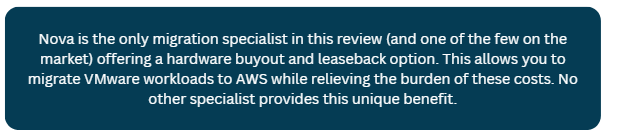
- Asset relief: Managing hardware costs during migration can be a major concern. Many organizations face pressure to replace outdated equipment or continue paying for support during a VMware exit.
- Target architecture clarity: You need clarity on whether to choose AWS native migration services or continue with VMware on AWS. The right partner will explain the trade-offs in cost, lock-in, skill requirements, and migration timeline, and provide a clear, tailored migration to your specific needs.
- Contract and renewal pressure handling: A specialist should help you sequence your migration around critical VMware renewal deadlines to avoid rushed decisions that could result in unwanted lock-ins or risk.
- Cutover plan and rollback strategy: It’s essential to know what “go-live” looks like. The right partner will test your environment before migration and provide a detailed rollback strategy to handle any issues that arise during the transition.
- Migration factory and automation: Does the provider use AWS services and tooling to reduce manual effort in discovery and execution? AWS migration tooling ecosystems streamline the process.
- Post-migration operating model: After cutover, who owns stabilization, incident response, and cost governance? Make sure the partner stays engaged to handle these tasks and ensure smooth operation post-migration.
- Risk controls: A migration partner must address the security baseline, IAM, network segmentation, backup/DR, and auditability before the mass migration begins. This ensures a smooth transition to AWS from VMware while meeting compliance standards.
Check out this video to understand how AWS Elastic VMware Service can support your migration strategies:
Final Take: Pick a Partner That Helps You Exit VMware Cleanly
There are many AWS cloud migration benefits, but moving away from VMware is an important decision that impacts your infrastructure's cost, stability, and long-term scalability. A specialist who can handle dependencies, migration sequencing, and provide post-migration stability will ensure a smooth transition to Amazon Web Services.
NOVA offers dedicated support through AWS-native migration, bridge support, and clear architecture guidance to help you migrate from VMware to AWS without the common pitfalls.
Contact us today for a detailed assessment and tailored migration plan.
FAQs
Why are companies moving from VMware to AWS?
Companies are moving from VMware to AWS because the acquisition of VMware has driven sharp price increases and reduced support flexibility, which raises operating costs and limits negotiation options. As a result, staying on-premises with VMware typically creates budget risk and long-term lock-in.
What services do VMware to AWS migration specialists offer?
VMware to AWS migration specialists offer assessment, planning, execution, and stabilization services that cover dependency mapping, renewal sequencing, cutover ownership, and post-go-live support. In practice, this includes guiding a VMware migration to AWS that reduces downtime and controls cost exposure.
What types of VMware to AWS migration specialists are there?
The main types include AWS Premier consulting partners, managed service providers, and technology platforms. Each model differs in how much execution ownership, automation, and post-cutover responsibility it provides during a cloud migration.
Pro tip: You can check out our guide on the top 10 VMware consulting partners to learn who can help you determine what's best for your company.
How to find VMware to AWS migration specialists?
VMware to AWS migration specialists are typically found through the AWS Partner Network, AWS Marketplace listings, and firms like NOVA that focus specifically on the VMware migration journey. These channels help validate experience as an AWS partner.
What happens after the migration is done?
After the migration is done, stabilization begins, followed by performance tuning, security hardening, cost governance, and ongoing operational support. This phase confirms that the new AWS environment runs reliably under real production load.
How long does a typical migration take?
A typical migration takes weeks to months because a true VMware exit requires dependency cleanup, architecture changes, security hardening, and cost controls.
Comments