
How the VMware VCSP Program Collapse Exposes Risk for Enterprises
Executive Summary
- The VMware Cloud Service Provider (VCSP) program’s collapse in 2025 exposed significant risks within VMware’s ecosystem. It marks a shift from broad partner access to a limited, invitation-only model.
- Enterprises now face the consequences of reduced partner choice, unpredictable pricing, and unclear roadmaps.
- The VCSP collapse proves that VMware environments are increasingly unstable, with the potential for future cuts to tools, features, and licensing models.
- AWS provides a stable, long-term foundation with predictable billing, global infrastructure, and consistent performance.
- NOVA helps enterprises safely exit VMware with minimal disruption and maximizes your AWS’s potential for growth and stability.
***
To evaluate your next steps, contact NOVA for a tailored discussion on how to exit VMware and transition to AWS.
Imagine learning overnight that your infrastructure partner of 10 years can no longer sell you licenses, renew contracts, or onboard new workloads.
On October 31st, 2025, that scenario became reality for thousands of enterprises when Broadcom's VCSP restructuring eliminated over 4,400 VMware partners worldwide, leaving roughly 200 authorized providers where there had been 4,500.
And with that shift, companies lost partner choice, escalation paths, and cost predictability that had previously supported the operating model for years.
As partner reduction narrowed access to authorized providers, decisions that once felt incremental have become time-bound and externally driven. So the question has changed. It stopped being about platform preference and became about control, exposure, and support continuity.
That is where NOVA steps in. It gives you a clear AWS-aligned exit plan that stabilizes your current environment temporarily, preserves service continuity, and lets you move on your timeline without extending VMware dependency.
In this article, you will see what this collapse exposed, and you will compare the paths now available to you. So, let's get started!
What Was the VCSP Program?
The VCSP program was VMware’s channel framework that let third-party providers operate and deliver managed VMware environments on your behalf.
Through the VMware Cloud Services Provider ecosystem, more than 4,500 partner companies delivered hosted VMware environments that looked and felt familiar while shifting day-to-day operations off your plate. This model mattered most in compliance-heavy sectors, where external audits, data residency, and support accountability shaped every infrastructure decision.
In practice, the program gave access to managed services without fully surrendering architectural intent.
- Providers handled capacity, patching, and support.
- Companies retained alignment with VMware’s tooling and lifecycle. They also remained responsible for their workloads.
For many organizations, this setup reduced friction across procurement and operations. It also created long-standing provider relationships that absorbed operational risk quietly, year after year.
At the same time, the VCSP model became a core distribution mechanism for VMware’s hosted and hybrid deployments. It extended VMware environments into hosted and hybrid contexts without forcing immediate platform change.
That convenience, however, came with growing vendor lock-in and reliance on partner pathways you did not directly control.
Note: After the Broadcom acquisition, the VCSP program contracted sharply, so many authorized VCSP providers were removed simultaneously. The structure companies depended on narrowed overnight without a gradual transition or customer-led migration window.
Here's a quick introduction to VCSP:
All of this leads us to what changed in 2025.
The 2025 VMware VCSP Program Shutdown: What Changed and Why It Matters
The VCSP ecosystem moved from broad access to a tightly controlled, invitation-only model, and that shift landed directly on your operating reality. After October 31st, the familiar partner landscape disappeared. It was replaced by a much smaller group operating under the Broadcom Advantage Partner Program.
At a high level, this was not a gradual adjustment. It was a cutoff. And with that cutoff came a set of immediate consequences that reshaped how you source support and plan forward.
The scale of disruption is unprecedented. Industry surveys show 98% of VMware customers are already using, planning, or considering alternatives, while 73% expect price increases exceeding 100%. Gartner predicts 35% of VMware workloads will migrate to alternative platforms by 2028.
These are the changes that defined the moment:
- Most partner companies were terminated from the program.
- Only around 100-200 authorized providers remained active.
- Many customer workloads sat between providers with no clean handoff.
- Support SLAs tied to deauthorized partners became unenforceable once authorization was withdrawn.
- Pricing expectations became unstable as options narrowed.
Taken together, these changes disrupted business operations without giving companies time to absorb or sequence the impact. Planning windows shrank, risk moved from abstract to immediate, and trust in the stability of VMware-native clouds weakened as decisions became externally imposed.
Note: What followed went well beyond technical impact. It became a people and planning problem, marked by frustration, churn, and conversations no one felt prepared for.
Now, the next focus is on how this disruption hit budgets, compliance, and daily operations.
Business Impact of the VCSP Collapse
Once the program narrowed, the impact showed up quickly across planning, operations, and accountability. What looked like a partner change on paper turned into a set of risks that landed directly on your team.
These are the effects that followed:
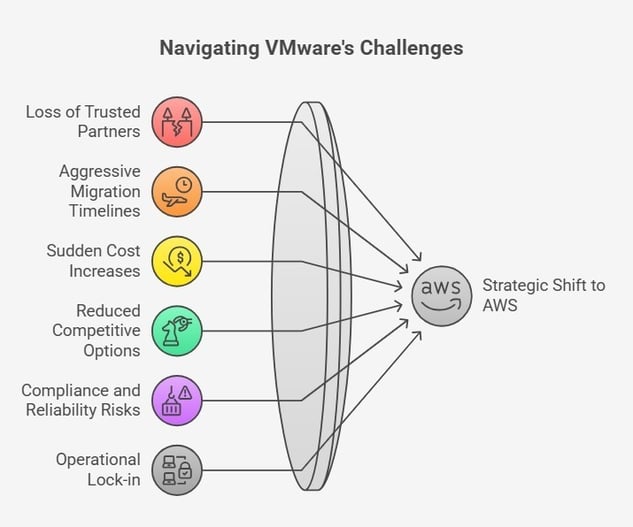
- Enterprises lost trusted partners: Long-standing partner companies that understood the environment, audit history, and escalation patterns were removed. That loss disrupted support continuity and weakened customer trust, especially where relationships had been built over many years.
- Time-pressured migrations replaced planned change: Contract end dates, expiring renewals, and partner exits compressed planning windows. Migration paths shifted from optional to time-bound, which limited the ability to stage work or align with internal change control.
- Sudden cost increases from remaining providers: As options narrowed, pricing leverage declined. Revised contract terms and rising VMware licensing costs surfaced late in the cycle, usually after budgets had already been approved. Price increases reported across the industry range from 800% to 1,500% for European customers, with some organizations seeing costs jump from $60,000 to over $650,000 under the restructured program.
- Reduced competitive options: With fewer authorized providers, negotiations became constrained. That reduction increased dependency risk and reduced the ability to benchmark service levels or pricing.
- Compliance and reliability risks: Gaps in documentation, support coverage, and audit alignment emerged during provider transitions, particularly in regulated environments. Maintaining business continuity required additional internal effort to close those gaps.
- Operational lock-in and maintenance window uncertainty: Changes to hosting arrangements introduced uncertainty around patching, upgrades, and outage coordination. Control over maintenance timing weakened as provider choice narrowed.
Note: These impacts hit hardest in healthcare, finance, public sector organizations, and MSPs. This is where regulatory obligations and service availability leave little room for disruption.
Moving on, let's see why this signals risk for every VMware customer.
Why the VCSP Collapse Is a Warning Sign for All VMware Customers
The VCSP collapse is a warning sign for all VMware customers because it showed how quickly external decisions can reshape your support options, pricing leverage, and long-term risk exposure.
What happened to partners was visible. What changed for your operating model is easier to miss, but more important.
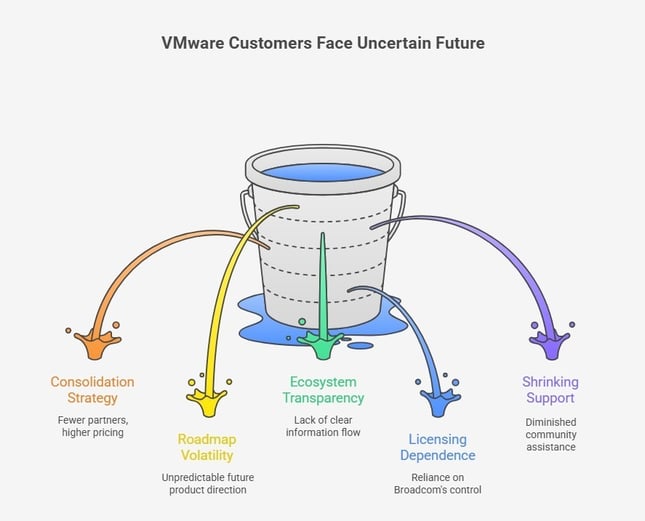
Broadcom’s Consolidation Strategy: Fewer Partners, Higher Pricing
As consolidation accelerated, the number of partner companies shrank while commercial leverage shifted upward. That change reduced choice and weakened negotiation power around renewals, support scope, and VMware license structure. Over time, fewer partners also meant fewer ways to absorb pricing shocks without rewriting budgets or contracts.
VMware Roadmap Volatility
Roadmap stability depends on predictability across tools, packaging, and delivery timelines. After the VCSP reset, visibility into future changes narrowed. That volatility makes it harder to plan upgrades, align internal dependencies, or justify long-term commitments tied to VMware Cloud Foundation-based environments.
Less Ecosystem Transparency
A broad partner ecosystem acts as an early warning system. When that ecosystem contracts, feedback loops tighten. Signals about policy changes, program shifts, or commercial adjustments surface later, usually after decisions are already finalized. That delay increases execution risk inside your technology infrastructure.
Increased Dependence on Broadcom-Controlled Licensing
With fewer intermediaries, licensing rules now flow more directly from a single vendor. That centralization reduces flexibility around contract structures, renewal timing, and consumption models. Over time, dependency increases while room to maneuver decreases, especially when terms change mid-cycle.
Shrinking Community Support
As partner tiers and indirect models disappear, shared operational knowledge erodes. Also, informal guidance, peer validation, and escalation shortcuts fade. That loss raises the cost of problem-solving and weakens business resiliency during incidents or audits.
Note: If thousands of partners can be removed with limited notice, this establishes a governance precedent. Nothing structurally prevents similar cuts to programs, licensing models, or commercial terms in the future. That risk now sits with every customer and not just those directly affected.
But what are your available and realistic options?
What Are Your Options Now?
Your options are now limited to three concrete paths: maintain your current VMware setup as a short-term stopgap, move workloads to one of the remaining authorized VCSP providers, or migrate VMware workloads onto AWS under a model you control.
With that framing in place, here's a little bit more detail about that.
1. Stay on VMware (Short-Term Only)
This path means keeping your current environment largely unchanged for now. It is usually chosen when contracts are still active, audits are in progress, or leadership needs breathing room before committing to a larger move. In the near term, operational processes stay familiar, and tooling, runbooks, and escalation patterns remain intact.
At the same time, this option works best as a holding pattern. Dependency risk does not decrease, pricing exposure stays unresolved, and planning becomes defensive rather than strategic, especially as renewal windows approach.
For many teams, this path buys time to align budgets, staffing, and internal approvals. It does not remove the underlying pressure created by partner instability or ongoing VMware licensing uncertainty.
2. Move to One of the Remaining VCSPs
This option involves relocating workloads from a terminated provider to one of the remaining authorized hosts. It appeals when you want to keep a hosted VMware model and avoid taking on infrastructure ownership internally. On paper, the platform experience looks familiar, and day-to-day operations can appear stable again.
In practice, this path requires careful validation. Capacity, geographic coverage, service tiers, and contract language now matter more because choice is limited.
Fewer providers mean less leverage and tighter timelines. Authorization remains externally controlled, and any move also introduces transition risk, even if the technology stays the same. As a result, this option typically stabilizes operations but does little to reduce long-term dependency or exposure.
3. Migrate to AWS
This option involves moving VMware-based workloads onto AWS-native infrastructure or compatible services that run within the AWS ecosystem.
It is typically chosen when long-term stability and vendor predictability carry more weight than preserving existing hosting models. Teams already using AWS usually view this as an extension of an environment they already trust.
After all, AWS remains the largest public cloud provider globally. It accounts for about 29% of the global cloud infrastructure market as of the third quarter of 2025.
Migration timelines for large enterprises typically span 18 to 48 months, with costs ranging from $300 to $3,000 per VM when using external providers. Notably, 44% of organizations experience unplanned downtime during migrations, making partner selection and planning critical.
That scale translates into sustained investment, global reach, and a mature operating model. For decision-makers, the appeal goes beyond performance claims. They expect that platform direction, support structures, and commercial models will not shift without notice.
At this stage, the choice is about deciding where long-term control should sit and how much uncertainty you are willing to accept along the way.
With those paths clear, the next focus is on why AWS serves as a strategic exit.
Ready to take control of your future? NOVA's VMware Freedom Initiative combines three pillars: bridge support that keeps your current environment stable during transition, asset relief that turns stranded on-premises hardware into working capital, and migration execution backed by AWS MAP funding. Contact us today to start your exit plan.
Why AWS Is the Strategic Exit from VMware
AWS is the strategic exit from VMware because it shifts control back to your organization instead of leaving it exposed to partner churn, licensing resets, and externally imposed timelines. After the VCSP collapse, stability stopped being about platform familiarity and started being about who controls pricing, support, and long-term direction.
Against that backdrop, these are the factors that make AWS an exit path rather than a lateral move.
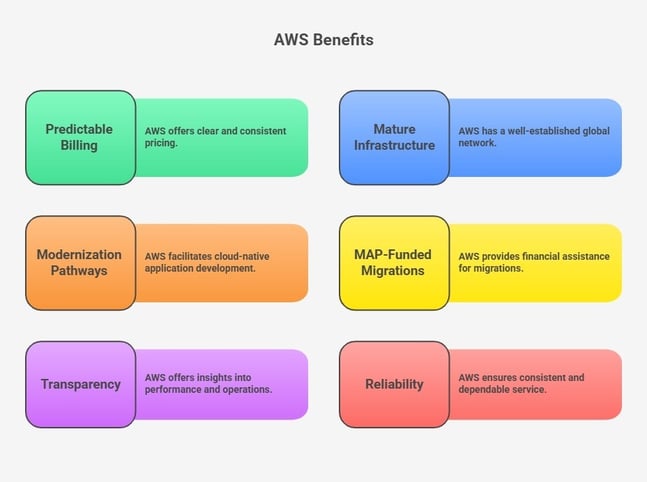
Predictable Billing
Cost volatility became unavoidable once partner options narrowed and pricing power consolidated. Under AWS, billing models are transparent, usage-based, and visible down to individual services and accounts.
That visibility matters when budgets must be defended months ahead of renewal cycles. It also matters when finance teams expect explanations tied to real consumption rather than revised contracts.
This concern is not theoretical. Budget disruption has become common in cloud environments without tight controls. That risk shows up clearly in a 2025 survey of 403 IT leaders responsible for cloud storage strategy, where 95% reported unexpected storage charges that disrupted budgets. The difference here is early visibility and control.
On AWS, cost drivers are exposed early, monitored continuously, and adjusted before they escalate into renewal or contract shocks.
Mature Global Infrastructure
The VCSP contraction exposed how dependent operations had become on a small set of providers with limited regional reach. However, AWS operates at a global scale that removes that bottleneck. Regions, availability zones, and network capacity are part of a single operating model rather than fragmented across partners.
As a result, placement decisions, failover planning, and regional compliance no longer hinge on which provider remains authorized. Infrastructure planning becomes a technical choice instead of a sourcing constraint.
Cloud-Native Modernization Pathways
VCSP environments typically locked modernization behind partner roadmaps and hosting constraints. AWS-native architectures remove VMware from the stack entirely, separating infrastructure decisions from application evolution. That separation allows gradual change without forcing platform resets or rushed rewrites.
Modernization can move in stages. Some workloads stay close to their current shape. Others shift to managed services when the business case is clear.
The key difference is sequencing. Change happens on your timeline, instead of it being a side effect of partner exits or contract expirations.
MAP-Funded Migrations
Forced timelines were one of the most disruptive outcomes of the VCSP collapse. However, the Migration Acceleration Program funding changes that dynamic. MAP offsets assessment and migration costs, which reduces the pressure to compress plans into unrealistic windows.
This matters because it allows proper staging. Security reviews, compliance validation, and operational readiness can run in parallel instead of being deferred. That way, migration becomes an execution plan.
When combined with asset relief strategies that convert stranded on-prem hardware into working capital, organizations can further reduce financial pressure during the transition.
Pro tip: Read our guide on the benefits of AWS migration so you can learn more about why you should choose this option.
AWS Transform for VMware
AWS Transform, generally available since May 2025, represents the next generation of migration tooling. Using AI-powered automation, it generates wave plans for 500 VMs in 15 minutes and performs network translations from VMware NSX to AWS VPC 80 times faster than traditional methods. Partners report up to 90% reduction in execution time compared to manual approaches.
This service replaced AWS Migration Hub for new customers as of November 2025, consolidating migration capabilities into a single platform with real-time analytics and collaborative workflows.
Performance and Operational Transparency
VCSP hosting abstracted performance and operational signals behind provider tooling. That abstraction limited visibility during incidents. AWS exposes metrics, logs, and service behavior directly, which shortens diagnosis cycles and reduces dependency on third-party escalation.
Operational transparency also supports internal accountability. Platform teams can explain performance tradeoffs, capacity decisions, and incident impact using shared data rather than provider interpretations.
Long-Term Reliability
The VCSP collapse demonstrated how quickly external governance can change. AWS reliability comes from direct platform ownership and documented lifecycle management, not partner authorization models.
Service lifecycles, support policies, and infrastructure expansion follow documented paths with advance notice. That predictability supports long-range planning.
Risk discussions move from “what if this partner disappears” to “how do we structure this workload over the next three years?” The difference is material when infrastructure decisions must survive multiple budget cycles.
How NOVA Helps Companies Exit VMware
At NOVA, we help you exit VMware in a way that preserves control, reduces exposure, and fits the constraints you actually operate under. We are not a hosting provider trying to keep you inside a shrinking ecosystem.
But we are the partner that plans, stabilizes, and executes the move out, with the explicit goal of removing long-term VMware dependency.
Here's what we can do for you, without forcing rushed decisions or artificial timelines.
Assessing Risk Before Committing to Change
The process starts with a clear view of what you are running today and why it matters. We assess your VMware workloads with a focus on operational dependency, renewal timing, and failure impact. That includes identifying which systems can move early, which must remain stable longer, and where partner or licensing risk concentrates.
Alongside this, we model cost scenarios across remaining VCSP options and AWS-native exit options. That comparison is grounded in real contract terms, operating overhead, asset disposition considerations, and migration effort rather than list pricing. The goal is to give you numbers that hold up in budget reviews and risk discussions, not optimistic projections.
Designing an Exit That Fits Your Constraints
Once the baseline is clear, we design an exit strategy that reflects how your organization actually works. In some cases, that means a staged move with a hybrid period. In others, it means a clean break once dependencies are resolved.
We support transitional hybrid states and full exits, depending on regulatory pressure, internal readiness, and contract timing. Our strategy does not aim to preserve VMware long-term, but to sequence its removal responsibly.
AWS Migration Acceleration Program funding plays a practical role here. Our team can help you apply MAP, which offsets assessment and migration effort. This reduces pressure on capital planning and avoids compressing timelines.
In parallel, NOVA can structure asset relief options, including hardware buy-back and lease-back, to convert stranded infrastructure into working capital during the migration window. That funding gives you room to sequence work correctly instead of cutting corners.
Stabilizing Operations While the Exit Is Underway
Exiting VMware does not mean accepting instability in the interim. So, our team provides bridge support to keep legacy environments secure, supported, and predictable while the transition is in progress. That support focuses on uptime, cost containment, and audit readiness rather than long-term dependency.
At the same time, modernization is applied selectively. We use services like EKS, ECS, and Lambda when they reduce operational burden or remove future constraints. When they do not, workloads stay closer to their current shape until change makes sense.
The difference is intent. We measure success by how much dependency you remove and not by how long you remain on transitional platforms. Our role ends when control is back in your hands, and the platform decision is defensible on operational and financial grounds.
Decide How Much Control You Want Going Forward
The VCSP collapse signaled that the VMware ecosystem can change without warning, and those changes land directly on your operating model. As partner choice narrows, predictability around support, pricing, and timelines weakens. That pressure forces a reassessment of where long-term control should sit.
AWS offers a stable foundation because platform direction, investment cycles, and support structures are visible and consistent over time. That stability matters when decisions must hold through audits, renewals, and budget cycles.
NOVA helps you exit VMware in a controlled way. Our bridge support keeps systems stable in the short term, while our migration planning steadily reduces dependency and licensing exposure.
To evaluate your options and next steps, contact NOVA for a focused discussion.
FAQs
What is the VCSP program?
The VCSP program was VMware’s framework that allowed third-party providers to host and operate VMware environments on your behalf. It shifted day-to-day operations and commercial management to partners while your teams focused on workloads and compliance.
Why did the VCSP program collapse?
The VCSP program collapsed because Broadcom replaced a broad partner ecosystem with a narrow, invitation-only model. That decision removed many providers at once and reshaped how support, renewals, and pricing could be sourced.
How many VCSP partners are left?
Only a small fraction of the original partner base remains authorized after the 2025 cutoff. That reduction materially limits choice, regional coverage, and negotiation leverage.
Is my VMware hosting provider affected?
Your hosting provider is affected if it was not invited into the new partner model after October 31, 2025. In that case, renewal rights and future service expansion are restricted even if short-term support continues.
What should I do if my VCSP partner lost authorization?
The next step is to assess contract timelines, operational risk, and dependency exposure tied to that provider. From there, planning either a controlled transition or a structured exit path from VMWare avoids forced decisions later.
Is AWS a viable alternative to VMware?
AWS is a viable alternative when long-term platform stability and control matter more than preserving a specific hosting model. It allows infrastructure decisions to follow documented roadmaps instead of partner availability.
Comments