
AWS Funding Programs Explained: Credits, Incentives, and How to Apply
Executive Summary
- AWS funding programs reduce migration cost only when the scope, architecture, and projected consumption are clearly defined and approved under structured review criteria.
- Incentives fall into migration, modernization, and co-investment models, each tied to workload volume, AWS-native adoption, and measurable usage growth.
- MAP remains the primary framework, while Activate, Marketplace incentives, and partner-led programs address specific scenarios such as VMware exit or startup workloads.
- Funding approval depends on validated workload inventory, target AWS-native architecture, and committed execution timelines.
- Cost impact increases when funding is paired with right-sizing and AWS-native services, where optimized migrations have shown infrastructure cost reductions of up to 66%.
- NOVA aligns funding strategy, VMware exit planning, and financial controls so funding and migration sequencing are financially controlled from the start.
***
Contact NOVA to evaluate your migration scope, align it with available AWS funding programs, and design a financially controlled path off VMware and onto AWS-native infrastructure.
If you’re evaluating AWS funding programs, you’re likely trying to quantify how much migration cost you can realistically offset.
You need to know what programs exist, which ones apply to your situation, and how much engineering effort they can cover. And more importantly, you need clarity on approval mechanics, scope conditions, and financial impact.
Because funding depends on certain eligibility conditions, it directly influences how you structure your AWS migration plan.
In this article, you’ll see:
- Which programs matter
- How they differ
- Where migration funding actually reduces cost
- What typically qualifies and what does not
Let’s dive in.
AWS Funding Programs: Comparison Table
Before selecting a program, you need a clear side-by-side view. So below are the core AWS funding options compared by structure, scope fit, and financial impact.
These are the programs you should evaluate when modeling migration cost reduction:
|
Program Name |
Program Type |
Best Fit Use Case |
Costs It Can Help Offset |
Who It’s Best For |
|
AWS Migration Acceleration Program (MAP) |
Migration + Modernization |
VMware exit, data center exit, large workload portfolio migration |
Assessments, migration engineering waves, and limited post-migration optimization |
Mid-market to enterprise; 40+ VM migrations; structured execution plans |
|
Partner Co-Investment within MAP |
Co-Investment (Partner-supported migration under MAP) |
Large VMware exit, strategic portfolio migration |
Partner-funded engineering tied to validated scope and consumption |
Enterprise migrations with approved AWS Partner involvement |
|
AWS Partner Funding Benefits (via Partner) |
Co-Investment |
Structured migration aligned through the AWS Partner Network |
Engineering effort bundled through a partner; promotional credits |
Organizations working with AWS Advanced Tier or specialized partners |
|
AWS Activate Credits |
Modernization / Usage Credits |
Startup workloads, innovation units, AWS-native adoption |
Eligible AWS service consumption (RDS, Aurora, EKS, ECS, serverless) |
Venture-backed startups; innovation subsidiaries |
|
AWS Marketplace Private Offer Promotion Program (MPOPP) |
Transaction Incentive |
ISV procurement via AWS Marketplace |
Portion of third-party software contract value |
Organizations purchasing through AWS Marketplace private offers |
|
AWS Startups Credits (Portfolio / Self-Serve) |
Usage Credits |
Product build, AI experimentation, early-stage AWS usage |
AWS-native service consumption only; no migration labor |
Early-stage or funded startups |
|
Partner-Led Commercial Initiatives (e.g., VMware Exit + Asset Relief) |
Commercial Co-Investment |
VMware licensing volatility, hardware refresh pressure |
Bridge support, asset relief, migration planning aligned to MAP |
VMware-heavy enterprises needing financial restructuring during migration |
Use this table to align funding type with migration scope. And more importantly, match incentives to the architecture path you intend to execute.
Now, let's start with the basics.
What Are AWS Funding Programs?
AWS funding programs are AWS-backed financial incentives that offset specific migration and modernization activities when you commit to defined AWS consumption.
They are structured to support:
- Cloud migration from on-premises or VMware environments.
- Application refactoring and modernization funding initiatives.
- Strategic AWS service adoption tied to measurable usage.
Typically, funding is applied to:
- Assessments and discovery phases.
- Migration engineering effort.
- Architecture changes that move workloads to AWS-native services.
Because large migrations drive long-term consumption, AWS allocates meaningful credit pools. For example, in one initiative tied to Generative AI, AWS committed $230 million in cloud credits, with up to $1 million per company for selected startups.
But funding is conditional. Approval depends on scope clarity, projected usage, and alignment with AWS objectives.
This leads us to the various types of AWS Funding Programs..
Types of AWS Funding Programs
Before you evaluate specific programs, you need to understand how AWS structures funding at a high level. In practice, incentives fall into three main categories.
Migration Funding
Migration funding is built to offset the engineering effort required to move workloads from on-premises or VMware environments to AWS. It is typically tied to:
- Infrastructure migration effort.
- VMware and legacy platform exits.
- Defined workload volume and committed migration scope.
Because AWS measures impact through consumption growth, incentives typically scale with the number of workloads moved.
For example, under the VMware Migration Accelerator within the Migration Acceleration Program, funding is structured across phases. Organizations can receive:
- Up to 5% of ARR in the Assess phase
- Up to 20% of ARR in partner cash during Mobilize
- Up to 25% of ARR in AWS credits in the Migrate & Modernize phase
- Additional credits for VMware-related workloads
In comparison, MAP Lite offers a simpler structure, typically providing 15% of ARR in credits during the early phases and an additional 10% during migration and modernization.
So funding is tied to both execution volume and post-migration usage, instead of just a migration plan on paper.
Modernization Funding
Modernization funding applies once workloads are already moving or have moved. It supports architectural shifts such as:
- AWS-native databases.
- Containers and serverless architectures.
- Managed services that replace self-managed infrastructure.
In most cases, these incentives unlock after or alongside migration milestones, especially when the modernization increases projected AWS service usage.
Co-Investment Programs
Some initiatives function as structured co-investment programs. These involve shared financial participation between three parties. Specifically:
- AWS: It allocates credits or incentive pools based on projected consumption growth.
- The customer: You commit to a defined migration scope, execution timeline, and agreed target architecture.
- The authorized partner: The partner contributes funded engineering effort and aligns the migration scope with AWS approval criteria.
These models are commonly used for:
- Large or strategic migrations.
- Multi-phase transformations tied to long-term AWS usage growth.
Next, we’ll look at the specific funding programs you can evaluate in practice.
Top AWS Funding Programs Available
You need clarity on which programs apply to your migration and how they help reduce cloud migration costs. So, below are the specific initiatives you should evaluate, with the approval mechanics and scope conditions explained clearly.
1. AWS Migration Acceleration Program (MAP) – Overview and Funding Details
The AWS Migration Acceleration Program (MAP) is AWS’s primary incentive framework to offset migration and modernization costs. It supports assessments, migration execution, and post-migration optimization within a structured methodology.
Funding is conditional and approved against a defined scope and projected consumption. It is delivered through AWS Promotional Credits and partner-funded engineering aligned through the AWS Partner Network.
So instead of generic rebates, you receive targeted support tied to milestones, workload volume, and validated migration plans. Here's a real example that illustrates this impact:
When RWS migrated to AWS to meet data residency and security requirements in Canada, MAP enabled the company to move quickly without service disruption.
“The AWS Migration Acceleration Program really helped us deliver on this transition very quickly.” - Nuno Linhares, Director of Cloud Operations at RWS
2. AWS Migration Acceleration Program (MAP) – Partner Incentive Improvements
Recent updates from AWS introduced more control and visibility inside AWS Partner Central, which makes MAP more partner-centric. So funding is now managed through partner approval workflows, with incentive pools allocated to approved partners under defined conditions.
These incentives are deal-specific and reviewed on a case-by-case basis. For example, you may see VMware exit incentives, data center exit incentives, or large workload portfolio incentives tied to projected revenue and scope.
Yet, they are not publicly listed catalogs. Approval depends on partner qualification under AWS Partner Programs, validated scope, and expected consumption outcomes.
Here's an explanation of what this program is:
3. AWS Partner Funding Benefits Guide (Includes MAP Funds)
The AWS Partner Funding Benefits Guide outlines how partners access migration and modernization incentives, including MAP and related programs, under broader funding benefits.
However, this is not a direct customer grant. Instead, it functions as a co-investment lever that partners use to structure and offset migration work.
Because funding flows through the partner, eligibility depends on program participation, milestone validation, and projected AWS usage.
As a result, partners may bundle funded engineering efforts or apply promotional credits to reduce your upfront migration cost, rather than transfer funds directly to you.
4. AWS Activate Credits (Startup Cloud Credits)
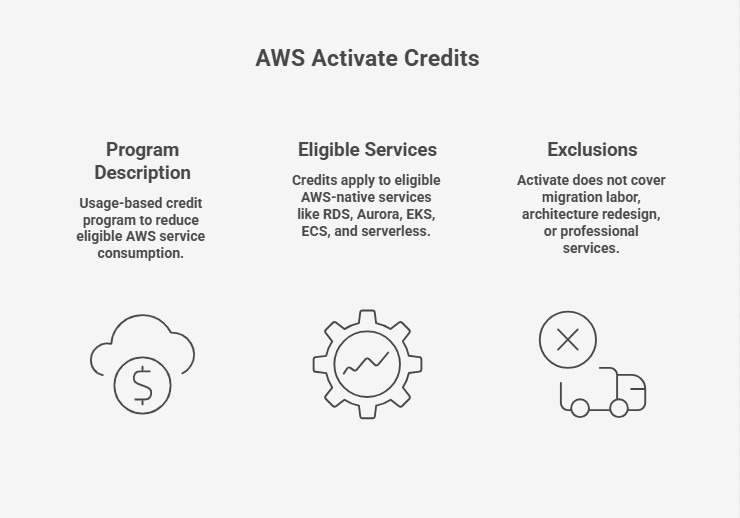
AWS Activate is a usage-based credit program designed to reduce eligible AWS service consumption. It does not apply to migration engineering costs.
If you operate a venture-backed subsidiary, product innovation unit, or early-stage workload inside a larger enterprise, these credits can offset infrastructure costs once workloads are running on AWS.
Credits apply to eligible AWS-native services such as Amazon RDS and Aurora, container services like EKS and ECS, and serverless services. They support adoption growth after migration milestones or during refactoring phases that increase measurable AWS usage.
However, Activate does not cover migration labor, architecture redesign, or professional services. It reduces operating spend tied to service consumption, not the cost of moving to AWS.
5. AWS Marketplace Private Offer Promotion Program (MPOPP) – Incentive Launch
The AWS Marketplace Private Offer Promotion Program (MPOPP) issues promotional credits to customers who purchase from participating AWS ISVs through private offers. Credits are calculated based on total contract value and released only after the Marketplace transaction is verified.
So when you procure third-party software through AWS Marketplace, this program can offset a portion of that contract through structured funding benefits.
That said, it does not fund migration engineering or architecture changes. It operates at the transaction level and links incentives directly to completed marketplace deals and validated revenue milestones.
6. AWS Startups Credits (Related to Activate)
The AWS Startups credit structure defines how eligibility, approval, and credit governance work under the broader Activate framework. Access depends on startup qualification criteria, provider sponsorship under the Portfolio track, or direct enrollment through the self-serve track.
Credits are issued under AWS Promotional Credit terms and are restricted to approved services. They cannot be applied to professional services, upfront commitments, or migration engineering. Approval is tied to the company stage, funding status, and alignment with AWS program requirements.
So while these credits can offset product build or artificial intelligence experimentation costs, they operate under structured eligibility rules and do not replace formal migration funding programs like MAP.
7. Partner-Led Commercial Initiatives (Non-AWS-Branded)
Not all migration incentives come directly from AWS. Some are partner-led commercial structures designed to align with MAP and extend its funding benefits under defined conditions. These initiatives are deal-specific and structured around measurable migration scope, consumption growth, and execution milestones.
For example, VMware exit programs combine bridge support with migration planning so youu avoid renewal spikes while preparing for transition. Asset relief models convert existing hardware into migration capital, which directly reduces upfront funding pressure.
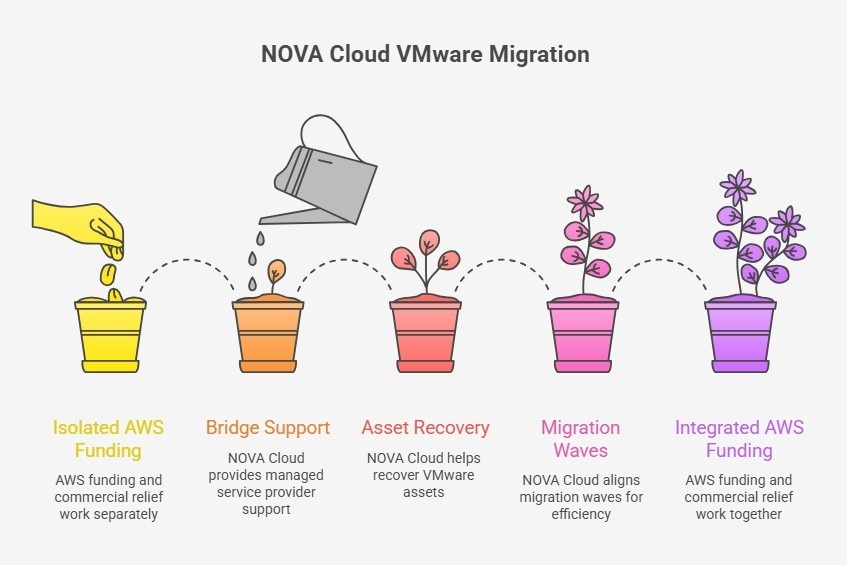
This is where NOVA’s VMware migration freedom initiative fits. As a managed service provider with MAP specialization, we align bridge support, asset recovery, and migration waves so AWS funding and commercial relief work together.
Beyond AWS Credits: NOVA’s Structured Migration Model
If AWS credits alone do not fully offset your migration cost, you still have structured commercial options. NOVA complements official funding with bridge support, asset relief, and MAP-aligned migration planning.
This model focuses on two clear outcomes:
- Exiting VMware entirely.
- Moving directly to AWS-native infrastructure.
Instead of shifting to another VMware-based model, you transition to EC2, RDS, Aurora, ECS, EKS, and other AWS-native services. That removes hypervisor exposure and reduces licensing unpredictability.
At the same time, NOVA aligns with AWS migration funding mechanisms. MAP incentives support assessments and execution. Asset relief converts hardware into migration capital. Bridge support stabilizes VMware temporarily while funding and planning move forward. So funding and commercial structure work together.
This model is built for organizations facing the following pressures:
- VMware licensing volatility.
- Data center exit deadlines.
- Large-scale re-platforming across complex workload portfolios.
If Broadcom renewal cycles, hardware refresh timelines, or portfolio-wide migration scope are forcing decisions, you need a financially structured path. We assess your environment, define migration waves, align the migration scope with MAP criteria, and integrate asset relief where applicable.
Schedule a conversation with NOVA to evaluate whether funding and asset relief can materially reduce your net migration cost.
What AWS Funding Programs Usually Fund (and Don’t Fund)
Before you model expected credits, you need clear scope boundaries. Funding programs follow defined approval rules, so realistic planning depends on understanding what qualifies and what does not.
What They Typically Fund
Funding focuses on work that drives measurable migration progress and consumption growth. These are the areas most programs support:
- Migration engineering effort: Structured workload moves from on-premises or another cloud provider into AWS. This includes discovery, dependency mapping, and execution waves tied to defined milestones.
- Architecture and refactoring work: Target-state design, right-sizing, and modernization that replaces legacy patterns with AWS-native services, sometimes including a scoped proof of concept.
- AWS-native service adoption: Implementation of services such as databases, containers, or serverless that demonstrate clear consumption outcomes and defined business impact.
What They Usually Don’t Fund
Funding is not intended for open-ended operating cost support. These are common exclusions:
- Ongoing operations: Day-to-day support, monitoring, and steady-state IT operations after migration completion.
- Long-term managed services: Continuous optimization retainers without defined migration milestones.
- Undefined or open-ended scopes: Broad transformation programs without workload inventory, timeline, or consumption forecast.
So when you structure your migration plan, clarity of scope directly affects approval probability and funding size.
Pro tip: Choosing the right partner often determines whether your migration stays on budget or turns reactive. Check out our guide on the top VMware consulting partners to see which providers enterprises evaluate and why.
How to Qualify for AWS Funding Programs
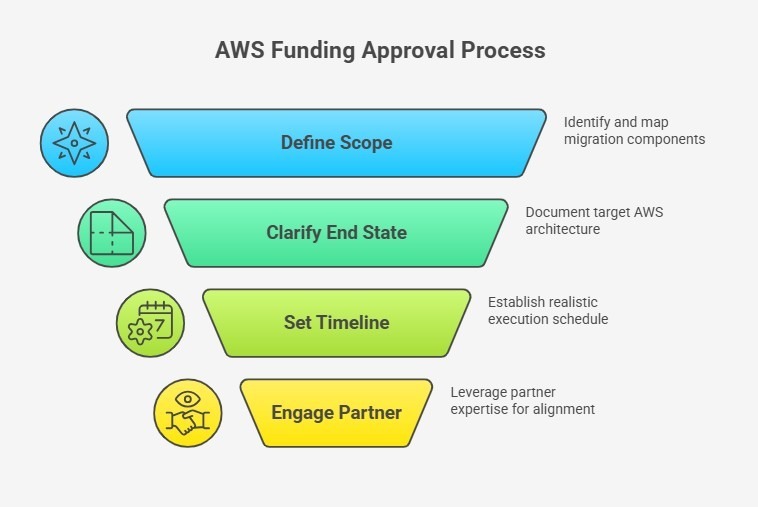
Approval depends less on intent and more on structure. So before you submit a request, align your migration plan to common qualification standards. These are the core requirements reviewers expect to see:
- Defined migration scope: A workload inventory, dependency mapping, and wave plan. Clear boundaries reduce risk, which directly improves approval probability within the standard funding cycle.
- Clear AWS end state: A documented target architecture that replaces legacy components with AWS-native services. That includes capacity estimates, cost projections, and defined service adoption. Don’t include abstract transformation goals.
- Committed execution timeline: A realistic schedule with start dates, phase milestones, and measurable completion criteria. Funding is tied to execution, so open-ended intent carries little weight during funding review.
Partner experience materially affects the outcome. And this is where structured guidance changes the approval probability. These are the practical advantages:
- Funding alignment: A partner familiar with AWS Specializations understands how to position the scope so it matches AWS review criteria.
- Scope control: Defined deliverables prevent drift, which protects funding eligibility.
- Faster approvals: Accurate documentation reduces back-and-forth during review, shortening decision time and lowering rejection risk.
The next step is learning how to structure AWS funding so that it materially improves your total migration budget rather than simply offsetting isolated costs.
How to Use AWS Funding to Maximize and Optimize Migration Budget
Funding creates value only when it reshapes your total cost model. So instead of treating it as a one-time credit, use it as a structured budget lever. Here are the practical ways to apply it.
Use Funding To
When aligned with execution milestones, funding directly changes cash flow and risk exposure. These are the primary applications:
- Reduce upfront migration cost: Apply approved funds to defined engineering waves and migration execution tasks. That lowers initial capital pressure and protects the budget during the early phases.
- Shorten parallel-run periods: Bridge periods where on-premises and AWS run simultaneously create double spend. Funding tied to execution speed allows you to compress that overlap window and reduce duplicate infrastructure cost.
Combine Funding With
Funding alone does not drive long-term savings. Its impact increases when paired with disciplined architecture decisions. These are the critical combinations:
- Architecture right-sizing: Move workloads with accurate capacity modeling instead of replicating on-prem sizing. In fac, Enterprise Strategy Group research shows that organizations migrating to AWS reduced compute, networking, and storage costs by as much as 66%. That reduction depends on workload optimization, not lift-and-shift alone.
- AWS-native services: Replace legacy patterns with managed databases, containers, or serverless where appropriate. Native adoption improves efficiency, which strengthens long-term budget control.
Common Mistakes Companies Make with AWS Funding
Funding can strengthen your migration plan, but only if it is structured correctly. Here are the common mistakes that reduce its real financial impact.
- Treating funding as “free money” without scope control: Credits are tied to defined milestones. When the scope expands without approval alignment, funding exposure increases, and approval risk rises.
- Choosing architectures just to qualify for incentives: Design decisions must follow workload requirements and cost modeling. Architecture built around incentives instead of business needs typically increases long-term operating costs.
- Delaying migration decisions while waiting for funding approval: Execution momentum matters. Research shows that one in three cloud migrations fail and only about 25% meet deadlines. Delays tied to uncertain funding typically compound schedule risk.
- Underestimating post-migration optimization costs: Migration is not the finish line. Right-sizing and service optimization drive savings, and those costs must be planned upfront.
Key Strategies for AWS Cost Reduction with NOVA
Cost reduction requires more than credits. It depends on structural, financial, and architectural decisions. These are the strategies NOVA applies to control migration and long-term cloud spend.
Asset Relief
During migration, capital constraints typically slow execution. NOVA and its partners, such as ReluTech, can purchase existing on-prem hardware and lease it back during transition.
That creates an immediate capital injection on Day 1, which can fund the AWS migration execution. At the same time, hardware shifts from CapEx to OpEx, which improves financial flexibility. After migration, stranded infrastructure is decommissioned or repurposed under a defined exit plan.
VMware License Optimization
Broadcom licensing changes introduced cost volatility and the 16-core minimum model. Migration to AWS-native removes that exposure.
Our bridge support stabilizes VMware temporarily while transition planning progresses. This helps you avoid forced renewals and protects the budget during execution.
FinOps & Waste Reduction
Cloud waste accumulates quickly without governance. NOVA identifies idle instances, oversized workloads, and storage inefficiencies. Real-time observability and structured spend management prevent VM sprawl and improve cost predictability.
Right-Sizing & Cloud-Native Adoption
"Lift-and-shift" approach alone preserves inefficiency. Instead, workloads are resized to actual demand. Services such as S3 Intelligent-Tiering and Spot Instances lower infrastructure cost while maintaining performance requirements.
Expert Migration & Support
As an AWS Advanced Tier Services Partner, NOVA uses defined pre-built migration playbooks and certified engineers to reduce migration errors and accelerate delivery.
Nearshore Cost Advantages
NOVA’s nearshore teams operate in U.S. and LATAM time zones, which means real-time collaboration without offshore coordination delays. At the same time, blended rates are typically lower than those of large U.S.-based consultancies.
That balance reduces overall program cost without lowering delivery quality. In several engagements, this delivery model contributed to measurable financial impact, including gains exceeding $250,000.
Structure Your Migration Funding for Real Financial Impact
AWS funding programs can materially reduce migration cost, but only when structured correctly. The biggest impact comes from choosing the right program and matching it to the right migration path. MAP, partner incentives, and commercial structures each fund different elements of engineering effort and AWS-native adoption.
However, funding alone does not create savings. It works best when paired with a clearly defined AWS-native target state, committed execution timeline, and disciplined scope control.
If you want funding to move beyond credits and reshape your migration budget, start with a structured plan.
Contact NOVA to evaluate your scope, align it with available programs, and design a financially controlled path off VMware and onto AWS-native infrastructure.
FAQs
Are AWS funding programs available for small or mid-sized migrations, or only for enterprise projects?
Funding is not limited to large enterprises. What matters is a defined scope, measurable consumption growth, and a clear execution plan. Smaller migrations can qualify if workloads, timelines, and target architecture are documented. Approval size typically scales with projected AWS usage.
Can AWS funding programs be combined with each other in a single migration?
In some cases, yes. Certain incentives can be layered, such as migration funding plus promotional credits. However, programs cannot duplicate coverage for the same scope. Alignment must be structured so that each funding source applies to a defined portion of the migration plan.
Do AWS funding programs apply to modernization after the migration is complete?
Modernization may qualify if it increases AWS-native adoption and consumption. Refactoring tied to measurable service usage can be funded. Ongoing operations or open-ended optimization generally do not qualify.
How long does it typically take to get AWS funding approved once a project is scoped?
Approval timelines vary, but structured submissions with clear milestones typically move through review within several weeks when documentation is complete. Incomplete scope or unclear forecasts typically extend review cycles.
What happens if a migration scope changes after AWS funding is approved?
Material scope changes usually require revalidation. If workload counts, architecture, or timelines shift significantly, then funding adjustments may follow. Clear change management protects the approval status.
Is AWS funding tied to specific AWS services or architectures?
Funding is commonly linked to AWS-native service adoption and consumption growth. Target architectures must be defined, and projected usage must align with AWS criteria.
Can AWS funding be used when exiting VMware rather than moving VMware to AWS?
Yes. Funding can support migration from VMware to AWS Native. However, continuing VMware tooling on AWS does not align with AWS-native funding priorities.
Comments