
Amazon Connect vs. Traditional Contact Centers: Cost, Risk, and Scale
.png)
Executive Summary
- Choosing between Amazon Connect and a traditional contact center is a structural decision that affects scalability, cost alignment, AI readiness, and change risk.
- Fixed-capacity models rely on upfront investment and overprovisioning, while elastic architectures align cost witovah real interaction volume.
- Customer experience outcomes differ under peak pressure, as elastic routing models handle demand spikes without fixed capacity constraints.
- Agent productivity improves when context, analytics, and assisted workflows operate inside a unified environment.
- AI adoption is easier when layered incrementally rather than bolted onto legacy infrastructure.
- Deployment speed and DevOps discipline determine whether change is disruptive or continuous.
***
If you need architectural clarity and a phased migration plan, book a discovery call with NOVA to assess your environment and define a controlled transition strategy
Choosing between an Amazon Connect contact center and a traditional platform is a structural decision that affects how you scale, how you fund growth, and how you introduce AI-powered automation without destabilizing operations.
Fixed-capacity systems were built for predictable demand. Cloud-native architectures respond to volatility and integrate natively with Amazon Web Services.
So the question becomes practical.
What changes in cost alignment, routing logic, deployment risk, and AI layering when you shift models?
In this article, we will compare trade-offs clearly, so you can evaluate what fits your operational reality.
Let’s begin.Amazon Connect vs. Traditional Contact Centers at a Glance
When you compare platforms, the real differences show up in how they handle load, cost, and change. To ground that comparison, here are the core contrasts between an Amazon Connect contact center model and a traditional call center environment.
|
Criteria |
Amazon Connect |
Traditional Contact Center |
|
Architecture & Scalability |
Designed to scale with demand without pre-provisioned hardware |
Capacity must be planned and provisioned in advance to handle peak load |
|
Cost Model |
Usage-based pricing aligned to interaction volume |
Fixed licensing and infrastructure costs regardless of actual usage |
|
Customer Experience |
Routing and automation can adapt to channel and demand |
Fixed routing logic and pre-defined menus |
|
Agent Experience |
Can consolidate routing, context, and tools into a unified agent workspace |
Agents switch between multiple systems to resolve one issue |
|
Analytics & Visibility |
Live view of wait times, sentiment, and resolution quality |
Analytics may rely on batch reporting or separate tools |
|
AI Readiness |
AI services can integrate natively through AWS |
AI may require separate tools and complex integrations |
|
Deployment & Change Management |
Configuration changes can be tested and deployed incrementally |
Changes may require downtime for scheduled updates and lengthy reconfiguration |
Next, let’s first clarify what typically defines a traditional contact center model and how its design assumptions shape your constraints.
What Defines a Traditional Contact Center
A traditional contact center is an on-premise or hosted system built on:
- Fixed infrastructure
- Pre-allocated licenses
- Capacity that must be purchased and configured before demand materializes
Capacity is planned months in advance, procurement cycles are long, and changes typically require vendor coordination.
Routing typically relies on static interactive voice response (IVR) trees and routing logic that require manual updates or vendor coordination to change at scale. As such,adapting workflows during demand spikes can be slower compared to cloud-native systems.
Also, real-time analytics are constrained, so operational insight typically arrives after the fact rather than during live traffic.
That structure has a financial impact.
For example, a study in the World Journal of Advanced Engineering Technology and Sciences found that on-premise contact centers spend 18-25% of their initial investment on annual maintenance, while 72% report difficulty scaling during seasonal demand shifts. As a result, scaling requires additional hardware, licenses, and staffing adjustments.
You can watch this short video to learn more:
With that clarified, let’s examine why many organizations are now reassessing this model.
Why Companies Are Rethinking the Contact Center
Companies are rethinking the contact center because pressure is building from multiple directions. Demand patterns shift faster, digital channels multiply, and expectations around response time and personalization continue to rise.
Let’s explore these in more detail:
First, expectations around speed and availability have changed.
Customers expect consistent service across channels and for context to carry over between touchpoints. That directly affects how you design customer interactions and measure customer engagement.
Second, traditional platforms were built for predictability.
Traditional platforms were designed for predictable workloads and fixed capacity. While many now offer AI features, embedding artificial intelligence and scaling dynamically may require additional tooling and integration work. As AI adoption accelerates (projected to grow from $1.6B in 2022 to $4.1B by 2027), platform limits become more visible.
And lastly, that shift requires a different infrastructure model.
Companies are moving toward cloud-native platforms that scale up or down based on demand. Instead of large upfront investments, consumption-based pricing aligns costs with actual usage. So the operating model becomes more flexible, data-driven, and easier to adapt as customer needs change.
Pro tip: Adoption patterns show how SMBs are modernizing service without a large upfront investment. Read our guide on contact center adoption trends to learn more.
This leads us to our next point.
What an Amazon Connect Contact Center Is
An Amazon Connect contact center is a cloud-native customer service platform built on AWS that scales automatically and charges based on actual usage. Instead of pre-purchasing capacity, you consume minutes and features as traffic occurs. Besides:
- Voice, chat, and messaging run in the same environment.
- Routing is configured through contact flows, which you can update without replacing hardware.
- Capacity scales based on demand without needing pre-provisioned hardware.
Deployment can start with a limited scope (e.g., single queue or business unit) and expand after performance is validated. Instead of planning for peak capacity months in advance, the cost tracks actual interaction volume.
This model also supports direct integration with AI and analytics services.
In fact, adoption trends reflect this shift. Amazon Connect has exceeded a $1 billion annual revenue run rate, and is growing over 30% year over year, with more than 20 million interactions occurring on the platform each day, which shows broad acceptance of this cloud-based approach.
Here's how this solution works in practice:
So, let’s compare it directly against traditional platforms across architecture, cost, AI readiness, and change management.
Amazon Connect vs. Traditional Contact Centers
At this stage, you're evaluating architectural trade-offs, cost behavior, operational risk, and readiness for AI features. That’s why we’ll focus on the core differences that affect scalability, financial alignment, customer experience, and change management.
Architecture & Scalability: Elastic vs Fixed
You don’t want peak demand to become a cost burden or a performance risk. Here is how fixed and elastic models behave under real traffic pressure.
Traditional Contact Centers
You must plan capacity months in advance, which means purchasing licenses, hardware, and staffing levels based on forecasted peaks. As a result, you may overprovision to protect service levels and absorb demand spikes.
You may need to do this during peak hours, when traditional centers may require 30-40% more staff than in off-peak periods.
Also, you can’t scale automatically; scaling depends on procurement cycles, configuration, and vendor coordination. When traffic exceeds planned limits, queues grow, and service levels drop.
Amazon Connect
With Amazon Connect, scaling is serverless and event-driven. Capacity adjusts automatically as voice calls increase or decline. And you do not pay for idle infrastructure during low demand.
This elasticity becomes critical during peak demand.
We’ve seen this in our work with MobilityADO, when we helped the company migrate its ticketing and API management system to AWS serverless architecture after facing outages during high-traffic periods.
The new setup automatically scaled from zero to peak demand, handled traffic spikes without downtime, and improved performance while shifting to a pay-for-value billing model.
Pro tip: Peak demand resilience requires proactive cloud scaling strategies, not reactive staffing. Read our guide on cloud scaling strategies before high-traffic events.
Cost Model: Capital-Heavy vs. Consumption-Based
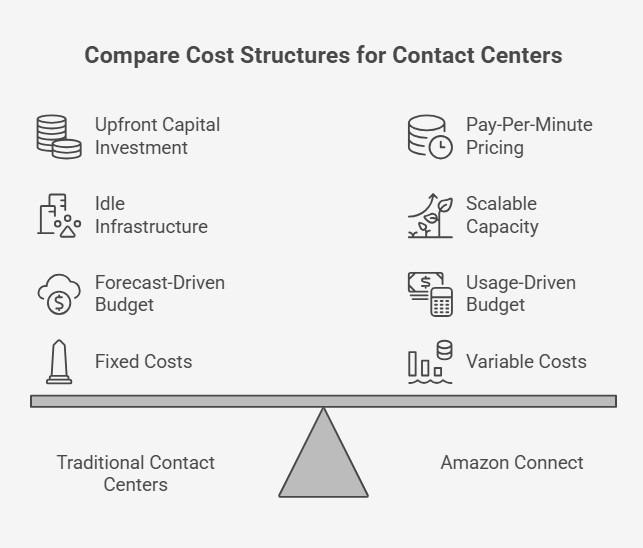
Cost structure shapes long-term financial risk. Here is how fixed investment compares with usage-based pricing in traditional vs Amazon Connect contact centers.
Traditional Contact Centers
In a traditional contact center:
- You commit upfront capital to hardware, licenses, and telephony infrastructure.
- Capacity is sized for projected peak demand rather than average usage. As a result:
- Infrastructure typically sits idle outside high-traffic periods, yet it still generates depreciation, maintenance contracts, and upgrade costs.
- Budget planning becomes forecast-driven instead of usage-driven.
- When call volumes increase or decline, costs do not adjust automatically.
This disconnect makes it difficult to align spending with actual contact volume or business growth.
Amazon Connect
With Amazon Connect, you pay for minutes used and features enabled. As such:
- There is no hardware lifecycle to manage and no stranded capacity during low demand.
- Cost scales with interaction volume, including support for global telephony when required.
- Your finance teams can link operational metrics directly to monthly spend because billing reflects real usage.
In 2025, Amazon Connect introduced all-inclusive AI pricing, bundling native AI capabilities like agent assist, self-service bots, and conversational analytics into channel-based pricing rather than charging per AI feature.
We applied a similar principle in our work with FullBeauty Brands, where NOVA reduced middleware licensing from $300K to $50K annually by redesigning the architecture around serverless consumption instead of peak-based licensing.
Customer Experience: Static Flows vs. Adaptive Journeys
Customer experience exposes architectural limits fast. When demand spikes, routing logic and staffing constraints directly affect outcomes.
Here are the structural differences between traditional contact centers and Amazon Connect that shape that experience.
Traditional Contact Centers
In traditional environments, IVR trees follow fixed paths, so:
- Callers select from rigid menus, and routing rarely adapts to context.
- Personalization is minimal because data is typically siloed and hard to access in real time.
As a result, peak demand translates into long hold times. That affects your bottom line because 66% of customers are only willing to wait about two minutes on hold, and 34% who hang up never call back.
In other words, traditional contact centers cannot absorb unexpected spikes.
Amazon Connect
With Amazon Connect:
- Routing adapts based on context and intent.
- Signals such as interaction history and customer profiles help guide callers toward the right path from the start.
- Voice, chat, and messaging operate within one environment, so continuity remains intact across channels.
The outcome is simple: faster access to the right resolution path, with fewer abandoned interactions during demand peaks.
If you're evaluating your contact center model and need a structured transition plan, NOVA can help. Book a call with NOVA to assess your current architecture and define your next step.
Agent Experience: Scripted Work vs. Assisted Resolution
Agent productivity is based on architectural design. When systems are fragmented, performance suffers. Here is how the two models differ from that perspective.
Traditional Contact Centers
In traditional setups, agents move between manuals, legacy dashboards, and disconnected tools. Context is rarely centralized. As a result, cognitive load increases and average handle time extends.
Training cycles also reflect this complexity. On average, call center onboarding takes 4-10 weeks, which signals how much system knowledge agents must absorb before becoming productive. When tools are fragmented, ramp-up time grows and consistency drops.
Amazon Connect
With Amazon Connect, agents operate inside a unified workspace. Customer context appears in one interface, which reduces system switching and manual lookups.
Importantly, Amazon Connect lets you monitor all interactions with AI-powered analytics. This gives your agents real-time context they can act on during live conversations. That visibility supports faster resolution and more stable agent performance.
Analytics & Insight: Reporting vs. Real-Time Intelligence
Data visibility shapes decision quality. When reporting lags, leadership reacts late. Here are the structural differences between traditional contact centers and Amazon Connect that affect how quickly you can act.
Traditional Contact Centers
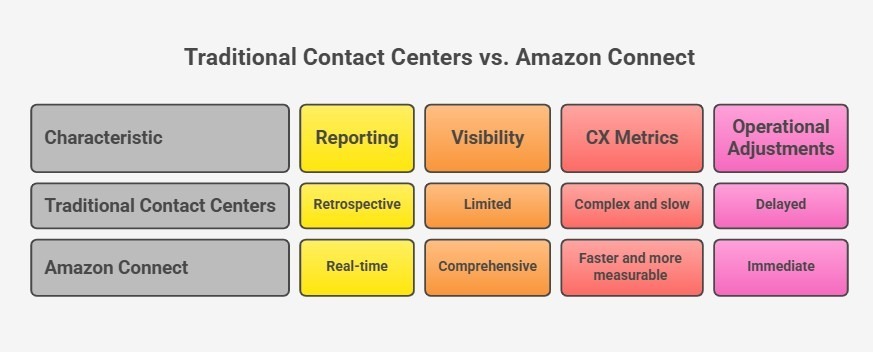
In traditional environments, reporting is retrospective. Performance data typically arrives hours or days after interactions occur. That delay limits:
- Your ability to correct staffing gaps or routing issues during live demand spikes.
- Visibility into intent and sentiment. Without built-in sentiment analysis, you rely on manual sampling or post-call reviews. As a result, connecting CX metrics such as AHT or CSAT to revenue impact becomes complex and slow.
Amazon Connect
Amazon Connect offers real-time metrics and continuously updated interaction data. Supervisors can monitor queue depth, handle time, and agent activity as traffic shifts. This allows:
- Immediate operational adjustments without waiting for end-of-day reports.
- Sentiment and intent analysis through tools like Contact Lens, which can analyze 100% of interactions.
That means tone, customer emotion, and conversation drivers are captured alongside traditional performance metrics. As a result, AHT, FCR, and CSAT are no longer isolated KPIs. They can be tied directly to conversation patterns, routing logic, and staffing decisions in real time, making performance improvements faster and more measurable.
AI Readiness: Add-On Automation vs. Built-In Foundation
AI adoption depends on contact center architecture, too. Here’s what you can expect with Amazon Connect contact centers versus traditional ones:
Traditional Contact Centers
In traditional environments, AI is typically added as a separate layer. That means integration through APIs, data synchronization, and custom connectors to third-party systems.
As a result, experimentation slows down.
Each new model or use case requires additional configuration, testing, and maintenance. Over time, integration overhead grows, and platform upgrades become harder to manage.
Amazon Connect
Amazon Connect is built to integrate with generative AI services from the start. It supports conversational self-service, agent assist, and summarization powered by Amazon Bedrock foundation models. In late 2025, AWS introduced 29 agentic AI capabilities, including autonomous AI agents that can reason through complex requests, take action across voice and chat channels, and hand off seamlessly to human agents when needed.
More importantly, adoption can happen gradually. You can automate first-line triage while keeping human escalation intact. AI handles routine queries, while complex or sensitive cases transfer to agents without disrupting workflows.
This structure allows step-by-step expansion of AI agents without replacing the full contact center stack. As a result, migration risk stays controlled, experimentation becomes easier, and automation maturity improves over time without forcing a platform rebuild.
Pro tip: If you’re evaluating vendors for AI-powered service transformation, compare capabilities beyond chatbots. Check out our guide to leading GenAI call center providers.
Deployment Speed & Change Management
Execution speed affects risk, cost, and competitive response. When changes take months, your growth stalls. Here are the structural differences between Amazon Connect and traditional contact centers that determine how quickly you can move.
Traditional Contact Centers
In traditional environments, implementations frequently extend over many months. Hardware provisioning, vendor coordination, and configuration cycles create long planning phases.
In some reported setups, deploying new features has taken up to 24 months, and subsequent changes averaged 9 months before reaching production. That delay directly limits your ability to respond to new service requirements or adjust routing logic.
Changes also introduce operational risk. Reconfiguration can require maintenance windows or staged cutovers, which increase downtime exposure and cross-team coordination overhead.
Amazon Connect
With Amazon Connect, initial setup can begin quickly and expand incrementally. You can roll out changes by queue, channel, or region rather than replacing the full environment.
This structure supports controlled pilots and measured iteration. Features related to self-service experiences or agent assistance can be introduced gradually and validated before wider release.
When Traditional Contact Centers Still Make Sense
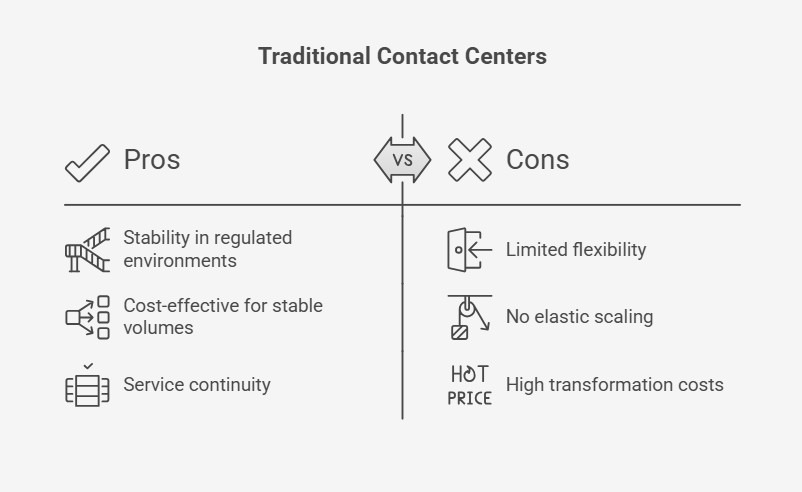
Despite the shift toward cloud platforms, there are certain operating contexts where a traditional model remains rational:
- Highly regulated environments with strict data residency or legacy infrastructure constraints may limit architectural flexibility. If compliance validation cycles are long and tightly audited, then replacing core systems can create operational exposure. In fact, call center satisfaction in banking sits at 82, which shows that strong performance is possible even under heavy compliance requirements.
- Organizations with low variability and stable call volumes may not need elastic scaling in the near future. When traffic patterns remain predictable year over year, fixed capacity can remain cost-aligned.
- Short-term scenarios where transformation is not yet feasible may justify maintaining the current setup. If budgets, contracts, or workforce structures delay modernization, then preserving stability can protect service continuity until a structured transition becomes viable.
Where Amazon Connect Is the Better Fit
Certain operating models require structural flexibility and don’t perform well with incremental optimization. Here are the environments where Amazon Connect aligns more closely with your priorities:
- Organizations facing demand volatility: If traffic changes due to seasonality, campaigns, or external events, you need Amazon Connect’s elastic scaling to absorb peaks without permanent overstaffing. As a result, service levels remain stable while idle infrastructure and excess labor costs decrease.
- Teams prioritizing cost transparency: Amazon Connect’s consumption-based pricing ties spend directly to interaction volume, giving you more financial control. Therefore, forecasting improves, and leadership can align operating costs with real usage.
- Contact centers planning AI-driven improvements: If AI is part of your roadmap, Amazon Connect’s built-in support for virtual assistants and agent assistance enables phased adoption without replacing the platform. That lowers integration risk and avoids parallel system overhead.
- Companies expanding across regions or channels: If you’re expanding on new markets or digital channels, Amazon Connect’s centralized routing and global telephony simplify your growth without any infrastructure rebuild. As a result, governance and reporting remain consistent across regions.
Implement Amazon Connect with NOVA
Platform selection is only part of the decision. Execution determines risk, cost alignment, and long-term flexibility.
With our AWS AI call center solutions, NOVA helps organizations move from strategy to controlled implementation in the following ways:
- Migrate from legacy contact centers: Migration plans are structured to reduce service disruption. Parallel routing, phased cutovers, and validation cycles allow continuity while traffic shifts gradually to Amazon Connect.
- Design scalable Amazon Connect architectures: Architectures are built for elastic growth, clear governance boundaries, and integration with existing systems. Capacity planning shifts from fixed hardware provisioning to usage-based scaling aligned to real interaction volume.
- Layer AI capabilities incrementally: AI features are introduced in stages, starting with targeted automation and expanding based on measured impact. This avoids full-stack replacement while enabling controlled experimentation.
Focus remains operational and measurable. The priorities are clear:
- Operational continuity: Service levels are protected through migration and optimization phases.
- Measurable KPIs: Metrics such as AHT, FCR, and CSAT are monitored and used to evaluate architectural and workflow changes throughout rollout.
- Human-in-the-loop support models: Automation handles first-line triage, while agents retain control of complex cases.
A clear example of our work from that standpoint is with Diri Telecomunicaciones.
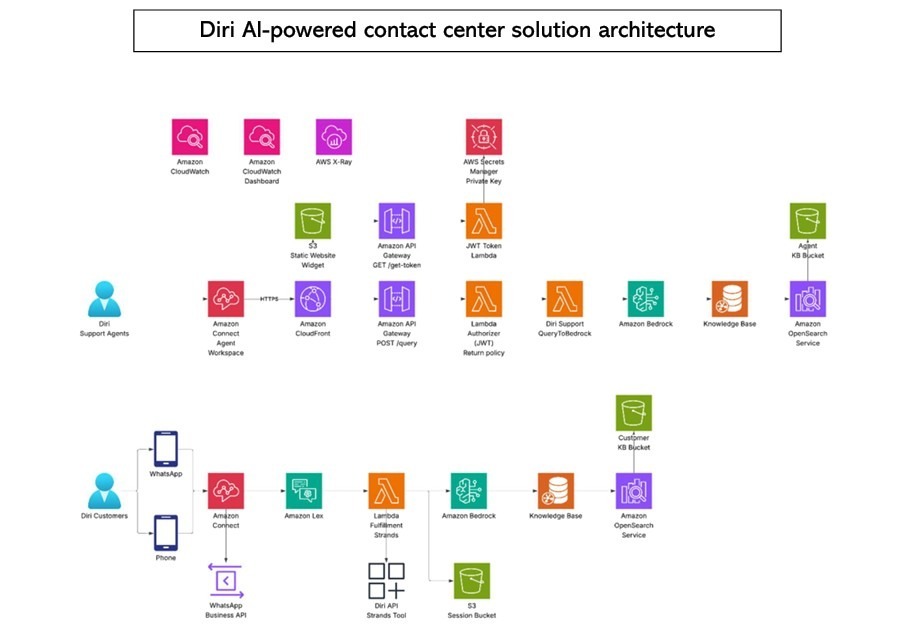
Diri operated across Mexico, Colombia, and Peru with 37 agents and experienced severe bottlenecks, including 43-80 minute wait times. The solution integrated Amazon Connect with Amazon Lex, AWS Lambda, and Amazon Bedrock Knowledge Bases.
Here’s how these worked together:
Lex identified customer intent, while a Lambda function invoked Bedrock for knowledge retrieval and answer generation. Meanwhile, sentiment detection continuously evaluated frustration signals. When escalation criteria were met, the system transferred the interaction to a human agent while providing AI-generated context inside the Agent Workspace.
The results were structural:
- Wait times reduced from 43-80 minutes to almost immediate responses.
- Real-time resolution of routine inquiries.
- Increased agent productivity through AI-assisted workspace tools.
- 24/7 intelligent support with seamless human handoff.
- Automatic serverless scaling during peak periods.
Demand did not decrease, but the architecture absorbed it. Here's how that architecture looks:
That is the difference between deploying a tool and engineering an operating model.
Conclusion: Choose the Right Contact Center Model
Choosing between Amazon Connect and a traditional contact center is a structural decision that shapes scalability, cost behavior, AI adoption, and operational risk. Fixed-capacity systems rely on forecasted peaks and upfront investment, while elastic architectures align spend with real interaction volume.
Customer experience, agent productivity, and real-time visibility all improve when routing, analytics, and automation operate inside one cloud-native environment. At the same time, certain regulated or stable environments may still justify traditional models.
The right choice depends on volatility, your growth plans, and AI readiness.
If you need architectural clarity and a phased migration plan, contact NOVA to define a controlled transition strategy.
FAQs
Is Amazon Connect a replacement for traditional contact center platforms or a complement?
That depends on your architecture and constraints. In some cases, Amazon Connect replaces legacy infrastructure entirely. In others, it operates alongside existing systems during transition. The decision should reflect integration complexity, compliance boundaries, and cost alignment goals.
How difficult is it to migrate from a traditional contact center to Amazon Connect?
Migration difficulty depends on integrations, routing logic, and data dependencies. However, risk can be controlled through phased cutovers and parallel routing. NOVA supports phased migration strategies to avoid downtime and preserve operational continuity while traffic shifts gradually.
How does Amazon Connect handle peak call volumes compared to traditional systems?
Traditional systems require pre-planned capacity and staffing buffers. In contrast, Amazon Connect scales automatically with demand, which reduces idle infrastructure and overstaffing during off-peak periods.
Can Amazon Connect support both human agents and AI-driven self-service at the same time?
Yes. You can run automation and live agents in parallel. NOVA deploys hybrid AI and human models using Amazon Connect and AWS Bedrock, where automation handles first-line requests and escalates complex issues to agents.
What are the most common risks when moving away from a traditional contact center?
The primary risks include integration gaps, change resistance, and misaligned cost forecasting. These risks decrease when migration is staged, and KPIs are tracked throughout implementation.
Comments