
AWS Funding Options Explained: Credits, Incentives, and Cost-Reduction Paths
Executive Summary
- AWS funding options include credits, milestone-based incentives, partner-led structures, and commercial flexibility, each with distinct approval paths and financial impact.
- Programs such as AWS Activate and MAP require a defined scope, documented milestones, and validated execution before credits or reimbursements are issued.
- Partner funding, MDF, marketplace financing, and private offers influence cash flow and deal structure, but do not automatically lower total spend.
- Funding supports architectural change, rather than steady-state IT operations or open-ended run costs.
- NOVA aligns VMware exit and modernization plans with eligible funding paths so financial models and migration sequencing remain consistent.
***
Book a call with NOVA to structure your AWS funding strategy around disciplined execution and long-term architecture decisions.
Migration and modernization budgets fail when your funding assumptions do not match how money is actually released, reimbursed, or applied. That gap becomes visible during VMware exit planning, large-scale re-platforming, or new service adoption.
You may hear broad claims about credits and incentives. But without understanding eligibility rules, approval paths, and milestone requirements, those claims can distort forecasts and create internal misalignment.
That’s why you need to look into AWS funding options more closely.
In this article, we discuss how credits, incentives, and commercial structures differ, plus what realistically applies to your migration plan.
Let’s begin.
What “AWS Funding Options” Really Means
"AWS funding options" is an umbrella term that refers to a group of mechanisms that AWS and its partners use to offset specific costs tied to migration, modernization, or early adoption. That includes AWS credits, structured incentives, and partner-led funding models.
Each category follows different rules:
- Credits apply directly to AWS service usage and are typically time-bound.
- Incentives may reimburse part of an approved migration plan after defined milestones are completed.
- Partner-led models route funding through delivery partners rather than directly to you.
For example, AWS offers up to $100,000 in AWS Activate credits for eligible startups. However, those credits apply only to qualified companies and defined services, instead of all migration scenarios.
So before you factor funding into your total project cost, you need to separate these categories clearly.
Next, let’s look at the main types and how they differ.
The Main Types of AWS Funding Options
Before you evaluate eligibility, you need to separate marketing labels from actual funding mechanics. AWS funding is delivered through different mechanisms, and each one affects your forecast differently.
So here are the four primary categories you need to distinguish.
|
Type |
What It Covers |
Key Notes |
|
AWS Credits |
Promotional credits applied directly to AWS usage |
Time-limited and restricted to certain services |
|
AWS Migration & Modernization Incentives |
Funding tied to workload migration and architecture changes |
Typically structured through partners and linked to specific projects |
|
Partner & Co-Investment Funding |
Funding that flows through the AWS Partner Network and joint execution models |
May not always be directly visible to the end customer |
|
Financing & Commercial Flexibility |
Payment deferral or structured payment plans |
Commonly tied to purchases through AWS Marketplace |
And the distinction matters.
- Credits lower billed usage within a defined window.
- Incentives depend on scope approval and documented execution before reimbursement is considered.
- Partner funding may offset part of the delivery effort, but it typically flows through structured engagements rather than directly into your AWS bill.
- Financing improves short-term cash flow, yet it does not reduce total spend.
Now, let's move into the specific programs you are most likely to encounter and how they actually operate.
Core AWS Funding and Credit Programs
When people refer to AWS funding programs, they usually mean a small group of named initiatives. These are the programs you are most likely to see referenced by account teams or partners.
Here are the primary ones you should evaluate carefully.
AWS Activate (Startups)
AWS Activate is built for startups that meet defined eligibility criteria, such as funding stage, affiliation with approved partners, or accelerator participation. It provides credits that apply directly to AWS service usage.
Remember: These credits apply to eligible cloud services only. They do not cover enterprise support plans or training programs.
And since its launch in 2013, AWS Activate has delivered around $7 billion in promotional credits globally.
However, approval depends on your eligibility and the defined time period. Credits have an expiration date, and they apply only to AWS service usage. They do not cover consulting fees or ongoing operating expenses.
Here's a video to introduce you to it:
AWS Migration Acceleration Program (MAP)
The Migration Acceleration Program, typically discussed as "AWS MAP funding", is AWS’s primary framework for large-scale migration.
It typically spans three phases:
- Assess: Discovering the existing environment, migration readiness evaluation, and development of the initial migration strategy.
- Mobilize: Preparing the AWS landing zone, security and governance frameworks, and detailed migration planning.
- Migrate & modernize: Executing migration waves, workload migration, and early modernization and optimization in AWS.
Funding typically includes migration incentives tied to projected AWS usage and partner-delivered execution milestones.
But the program requires a defined scope, workload inventory, and projected consumption model. Reimbursement or credit allocation depends on milestone completion and validated execution.
This is where architecture decisions, migration sequencing, and partner involvement directly influence funding eligibility.
You can watch this video to learn more:
Pro tip: MAP funding works best when migration sequencing and milestone validation are structured upfront. If you're planning a phased exit, read our guide on building a smarter AWS migration plan to align scope with funding eligibility.
AWS Proof of Concept (PoC) Credits
PoC credits support validation efforts for new initiatives. These may include:
- AI and machine learning use cases
- IoT deployments
- New architectures
- Adoption of new AWS services
In some cases, AWS runs focused programs to encourage experimentation. For example, the AWS Artificial Intelligence & Machine Learning PoC Program can provide up to $1,500 in credits along with limited technical support to help you begin testing on AWS.
Scope remains limited and milestone-based. You submit a defined validation plan, and funding applies only within that approved window. It does not extend into production rollout unless separately approved.
Remember: There is no single, always-on global “AWS PoC Credits” program with standardized terms. These are typically:
- Region-specific
- Industry-specific
- Account-team driven
- Time-limited campaigns
Innovation Sandbox / Experimentation Credits
Programs such as APN Innovation Sandbox support short-term experimentation. These are typically used during early prototyping or joint development efforts.
Credits typically offset short bursts of AWS usage. They are structured around defined test cases and do not replace structured migration incentives.
AWS Imagine Grant (Nonprofits)
The AWS Imagine Grant supports mission-driven organizations. It may include credits or direct funding support.
However, it is not migration-specific. Eligibility depends on nonprofit status and program criteria rather than technical architecture or modernization goals.
Next, we’ll examine how partner-led funding structures work and why they rarely appear as line items in your AWS bill.
Partner-Specific AWS Funding Options
Beyond public programs, a significant portion of funding flows through partners. These mechanisms sit inside AWS Partner programs and typically support joint execution, rather than direct customer grants.
Here are the partner-driven structures you should understand.
Marketing Development Funds (MDF)
Marketing Development Funds are allocated to partners to support demand generation and promotion of AWS-based solutions. This may include campaigns, events, or co-branded initiatives tied to specific services.
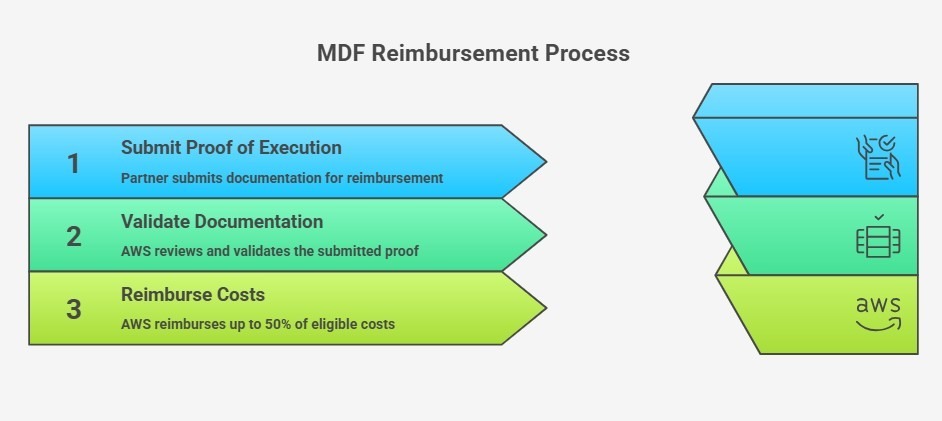
Remember: MDF is partner-facing. It is not a cash grant to your company. The partner incurs the cost first, then submits proof of execution for reimbursement.
In practice, MDF can reimburse up to 50% of eligible marketing activity costs after documentation is validated.
In certain initiatives, allocations can be material. For example, recent updates from the AWS APN Blog show that AWS may provide up to $50,000 in MDF for Amazon Connect–related campaigns in 2026.
However, this funding supports your marketing efforts, not migration execution or infrastructure build-out.
ISV Workload Migration Funding
Independent Software Vendors (ISVs) that migrate their applications or customer workloads to AWS may qualify for structured co-investment programs.
These programs typically support activities such as SaaS transformation, architectural redesign, or enabling customers to run the ISV’s product on AWS infrastructure.
Funding is usually structured through broader frameworks such as MAP or partner-led incentives. However, this funding agreement is between AWS and the ISV, so it’s not automatically between AWS and each end customer.
If an ISV receives migration support, that benefit may indirectly influence customer onboarding costs. But it does not automatically reduce a customer’s AWS bill unless explicitly structured that way.
Training & Certification Vouchers
AWS also provides discount vouchers for exams and formal training. These reduce certification expenses for approved teams.
But there is a clear boundary: these are vouchers, not service credits, so:
- They do not offset AWS usage or infrastructure spend.
- They are not cash reimbursements.
So while training vouchers can support long-term capability building, they do not directly reduce migration budgets.
Pro tip: Not all partner-led funding models deliver equal oversight or approval predictability. Before selecting a delivery structure, review our comparison of top AWS consulting partners to assess execution depth.
Moving on, let’s look at how marketplace and commercial flexibility options work.
Planning a VMware exit or AWS modernization? NOVA helps you align workload sequencing, architecture decisions, and funding eligibility from day one. Book a strategy call to structure your AWS funding path around real execution.
AWS Financing and Marketplace-Based Options
Not every funding mechanism lowers your bill directly. Some options adjust payment timing or deal structure instead. These are typically grouped under AWS funding programs, yet they function differently from usage credits.
Here are the primary models you should evaluate.
AWS Marketplace Financing
Marketplace financing allows you to spread payments for software and services purchased through AWS Marketplace. As such, you gain commercial flexibility, rather than a discount.
Instead of paying the full invoice up front, you may apply to pay certain Marketplace invoices in installments for up to 48 months once approved. That means you’re not facing harsh cash flow pressure during large migrations or SaaS transitions.
However, the total contract value remains the same because financing improves budget sequencing, but doesn’t reduce AWS consumption charges or service fees.
So when you model migration spend, treat this as payment restructuring instead of cost reduction.
Pro tip: Commercial flexibility improves payment timing, but long-term savings depend on architecture and usage discipline. See how teams cut spend in our guide on AWS cost optimization services.
Private Offers & Commercial Credits
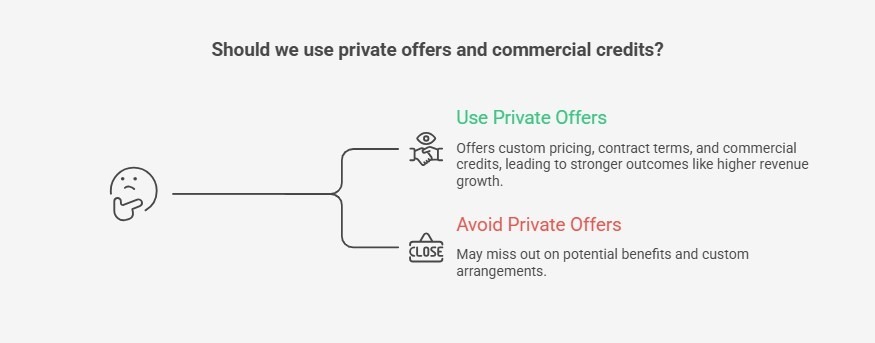
Private offers are deal-specific arrangements negotiated between you, AWS, and the seller. These may include custom pricing, contract terms, or structured commercial credits.
Pro tip: Private offers may also be structured through Channel Partner Private Offers (CPPO), where an AWS partner participates in the transaction and delivers the solution through AWS Marketplace.
And unlike public programs, private offers are not automatically visible. They require negotiation, alignment with projected spend, and defined commitment levels.
Market research shows that ISVs using structured private offers and co-sell strategies saw stronger outcomes. For example, partners reported 51% higher average revenue growth and 65% higher close rates when private offers were tied to Marketplace and co-sell motions. That context matters because commercial structure can influence deal size and timing.
Still, private offers are conditional. Approval depends on projected usage, competitive positioning, and internal AWS priorities.
Next, we'll explain what funding AWS typically covers and, just as important, what it does not.
What AWS Funding Options Typically Cover (and Don’t)
Before you model expected funding benefits, you need to separate what is usually supported from what is not.
Funding is tied to defined transformation outcomes, so these are the areas most commonly covered:
- Migration effort: Moving defined workloads from on-premises or another cloud into AWS under an approved plan. This is typically aligned with structured programs such as AWS MAP funding.
- Architecture changes: Reworking application components so they run differently on AWS. For example, replacing self-managed infrastructure with managed services.
- AWS-native service adoption: Introducing services like managed databases, analytics platforms, AI/ML tools, or serverless compute as part of a scoped modernization initiative.
And just as important, several cost categories are typically excluded. These are the areas you should not expect funding to absorb:
- Ongoing managed services: Day-to-day operational support once migration milestones are complete.
- Open-ended operations: General AWS run costs that are not tied to a defined project phase or measurable outcome.
- Legacy platform extensions: Extending existing environments without materially changing architecture or operating model.
So funding supports change, instead of maintenance.
Pro tip: Funding supports architectural change, though maintenance is not covered. If you’re weighing modernization against extension, read our analysis of VMware licensing cost shifts in 2025 before modeling your next move.
Let’s now look at how you actually access these options and move through the approval process.
How to Access AWS Funding Options
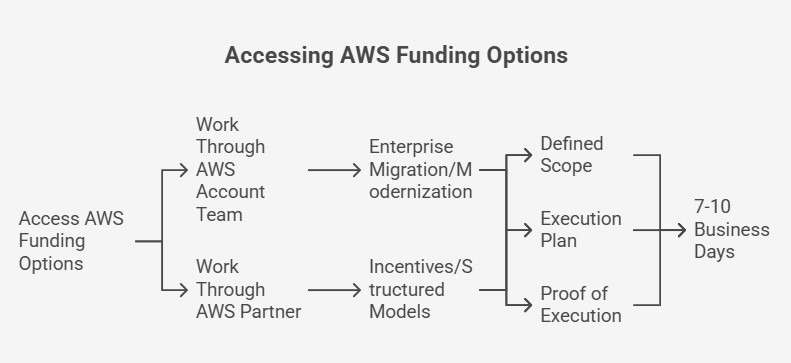
Access does not happen automatically. You typically engage through one of two channels, and each follows a different approval workflow.
First, you work through your AWS account team. This route is common for enterprise migration or modernization initiatives, especially when programs such as AWS MAP funding are involved.
Second, you work through an AWS Partner. Many incentives and structured models move through partners, who submit requests on your behalf and align funding with a defined delivery plan.
However, access depends on preparation. These are the typical requirements you will need to meet:
- Defined scope: Clear workloads, timelines, and measurable outcomes.
- Execution plan: Architecture approach, migration phases, and resource allocation.
- Proof of execution: Required for cash-based incentives, usually after milestones are completed.
And while smaller programs can move faster, timelines still apply. For example, 7-10 business days is a typical review period for AWS Activate credits, which shows that even credits follow a formal review cycle.
So, approval depends on documented scope and execution planning, not just the stated migration intent.
Expand Your AWS Funding Options with NOVA
Accessing funding is one step. Structuring your migration so it qualifies and delivers measurable impact is another. That is where NOVA steps in.
Here is how we support you.
NOVA’s Role
NOVA focuses on real infrastructure change, rather than incremental adjustments. In practice, this is how we help:
- Support full VMware exit strategies by designing and executing structured transitions to AWS-native architectures.
- Adopt AWS-native infrastructure instead of replicating legacy virtualization layers in the cloud.
- Implement new services such as managed databases, analytics platforms, or AI capabilities, such as Amazon Bedrock, where relevant.
- Modernize core infrastructure using AWS services that shift operational models, instead of just hosting locations.
And beyond execution, strategy matters. NOVA aligns your migration plan with available funding paths. That includes:
- Structuring workloads and phases to match cloud migration funding criteria.
- Coordinating with AWS account teams and partners to align scope with defined funding mechanisms.
The result is a migration plan that supports eligibility rather than conflicting with it.
What NOVA Does Not Do
Clarity builds trust. So, it is equally important to state what NOVA does not provide:
- We do not resell VMware.
- We do not recommend VMware-on-AWS overlays.
- We do not sell VMware licenses.
Instead, the focus remains on long-term architectural change.
Funding-Aligned Capabilities
Some organizations need time or capital before full migration. NOVA addresses that gap with structured options.
Bridge Support provides:
- Temporary VMware stabilization: This allows you to keep critical workloads running safely while you define the migration sequence and target architecture.
- A controlled timeline to plan migration properly: Instead of rushing into lift-and-shift decisions, you gain time to redesign workloads in a way that aligns with funding criteria and long-term operating goals.
Asset Relief includes:
- Hardware buyout: Existing on-premise assets can be acquired through structured agreements, so you are not forced to wait for depreciation cycles before moving forward.
- CapEx-to-OpEx conversion: Infrastructure spend shifts from upfront capital investment to operating expense, improving budget flexibility during transition.
- Day-one capital support: Early financial relief can help fund initial migration phases before AWS-based incentives are realized.
So, funding is not treated as a marketing lever. It becomes part of a broader financial and technical plan.
How to Choose the Right AWS Funding Option for Your Situation
Choosing the right option starts with context, rather than availability. Funding should fit your operating model and transformation goals.
Start with two practical filters:
- Company type: A startup may qualify for structured credits, while an enterprise migration usually aligns better with milestone-based cloud migration funding. ISVs may access incentives tied to workload moves or co-sell motions.
|
Company Type |
Typical Funding Path |
What Must Be True |
|
Startup |
AWS Activate credits |
Must meet eligibility criteria based on age, funding stage, partner affiliation, or accelerator participation. Credits apply only to eligible AWS usage and expire within a defined funding cycle. |
|
ISV |
Workload Migration incentives |
Funding tied to first-year AWS ARR. Requires a defined migration plan and revenue validation. |
|
Enterprise |
AWS MAP funding |
Scope, milestones, and migration phases must be documented within the funding process before approval. |
- Migration vs. modernization goals: A lift-and-shift plan has different funding pathways than a refactoring initiative that changes architecture and service usage.
Then evaluate alignment:
- Funding should support your strategy: Structure incentives around defined workloads, timelines, and measurable outcomes.
- Funding should not dictate architecture: Avoid selecting services solely because they qualify for credits if they increase long-term IT operations complexity.
In short, funding is a tool within your broader plan. When aligned with a clear funding process, it strengthens execution without distorting technical decisions.
Structure Your AWS Funding Strategy With Clarity
AWS funding works when structure, scope, and execution are aligned. Credits, incentives, partner-led models, and commercial flexibility each follow different rules, and misreading those rules distorts budgets. So before you commit, confirm what applies to usage, what depends on milestones, and what simply shifts payment timing.
And just as important, design architecture around your long-term operating goals, rather than short-term credits. When migration phases, workload scope, and financial assumptions are documented clearly, approval becomes more predictable.
If you want funding aligned with a real VMware exit or modernization plan, contact NOVA to structure your next step with clarity.
FAQs
How do AWS funding options differ from traditional cloud discounts?
Traditional discounts lower unit pricing based on committed spend. AWS funding options, by contrast, are typically milestone-based or project-scoped. Credits and incentives apply to defined activities such as migration waves or new service adoption. So instead of reducing every bill line, funding supports specific transformation outcomes.
Why does AWS rely so heavily on partner-led funding instead of direct customer grants?
Partner-led models provide execution oversight. When funding flows through an approved delivery partner, AWS gains validation that the scope, architecture, and milestones align with program criteria. As a result, risk decreases, and approval becomes more predictable.
What conditions typically cause AWS funding to be approved or declined?
Approval depends on documented scope, measurable outcomes, and projected AWS usage. Requests without defined milestones, revenue impact, or architectural change are typically declined.
Are AWS funding options tied to specific architectures or AWS services?
In many cases, yes. Funding is commonly linked to adopting managed services, refactoring workloads, or replacing legacy patterns. Pure hosting replication may qualify less frequently.
How do AWS funding options influence migration timelines and sequencing?
Funding typically follows phases. Hence, migration waves are structured around milestone completion and usage validation, rather than arbitrary calendar dates.
Comments