
How to Implement Generative AI in Your Business: Complete Strategy Guide

Executive Summary
- Implementing generative AI requires solid data foundations, clear readiness, and a model strategy built for real production workloads.
- Successful rollouts rely on strong internal governance frameworks, active monitoring, and disciplined control of cost, accuracy, and system behavior.
- High-value gains come when teams tie GenAI to measurable outcomes like lower handling time, better resolution quality, and faster delivery cycles.
- Scaling GenAI needs shared standards, coordinated teams, and long-term planning across architecture, oversight, and integrations.
- NOVA delivers the readiness, POC execution, and production frameworks that help you architect and operationalize stable GenAI systems with predictable performance and controlled risk.
If you want a structured path to enterprise-grade GenAI, NOVA can guide your entire lifecycle. Reach out to start your roadmap today.
***
You might be facing pressure to implement generative AI in your business without adding risk to your operations. Or creating systems your teams can’t maintain.
And you know that progress doesn't just depend on model selection. It hinges on architecture choices, data quality, guardrails, and a path that moves from pilot to production without surprises.
Well, we can help you out.
In this guide, you’ll see how to set that path. You’ll compare options and decide what moves first. So, let's get started.
What Does It Mean to Implement Generative AI in Business?
Implementing generative AI in business means applying systems that create language, insights, or outputs that support your operations in a controlled and measurable way. We advise you to treat it as a strategic capability that influences workflows, cost structures, and the speed at which your teams deliver outcomes.
And you should use it with clear boundaries because Gen AI can summarize, synthesize, and assist with reasoning tasks. Meanwhile, it still struggles with factual accuracy, regulatory constraints, and consistent quality without strong data management and oversight.
But even though it has its downsides, it's still widely used today. According to McKinsey’s 2025 survey, 79% of organizations now use GenAI in at least one function. This signals how quickly these practices are becoming standard.
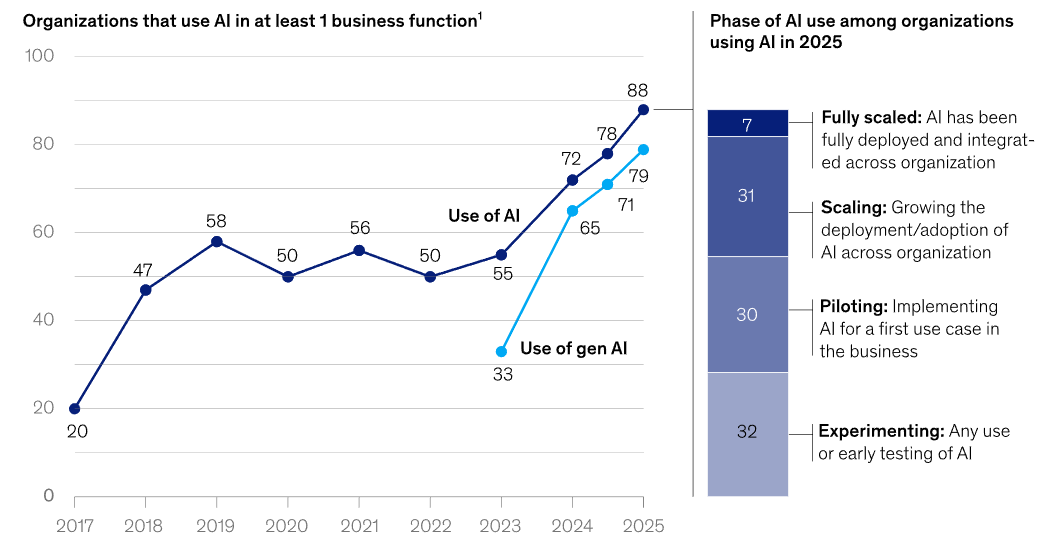
Source: McKinsey & Company
Differences Between GenAI, AI, and ML
- GenAI produces new content and decisions using large language model architectures.
- Broader AI applies logic and rules.
- Machine learning systems classify, predict, or score patterns.
So you evaluate GenAI through its direct impact on customer experience, process optimization, and where creative or unstructured tasks block scale. This helps you decide where GenAI improves operational efficiency and where traditional models remain a better fit.
Here's why enterprises adopt GenAI in the first place:
- Automation that reduces workload across enterprise AI systems.
- Improved routing assistance and resolution quality across customer support channels.
- Better data analytics for decision-making.
- Faster workflow generation and content creation.
This brings us to our next point...
Why Generative AI Matters for Modern Enterprises
Generative AI matters because it reshapes how you drive outcomes across operations, revenue, and customer-facing work. It gives you a way to build an AI strategy that supports scale without creating more overhead for your teams.
Here are the areas where GenAI moves the needle for you:
- Competitive differentiation: Create experiences and workflows your competitors can’t match. This is especially true as markets shift and expectations rise for faster digital delivery.
- Cost reduction and operational efficiency: Streamline repetitive tasks and support more efficient work routing across assisted workflows, contact centers, and engineering teams. And this matters even more now because companies using generative AI are averaging $3.7x ROI. This shows how quickly gains appear when the right controls are in place.
- Improved customer experience and personalization: Respond faster through customer service channels and adapt interactions in ways that raise satisfaction.
- Faster product cycles and time-to-market: Reduce friction across design, testing, and release steps and support decisions with better predictive analytics.
- Automation, augmentation, and data-driven innovation: Shift effort from manual work to higher-value tasks while keeping responsible AI practices in place.
And here’s where NOVA strengthens this further.
NOVA pairs GenAI with Amazon Connect to augment routing logic, guide agents with real-time context, and handle repetitive requests without adding strain to your teams. This gives you faster resolutions, steadier outcomes, and a contact center environment enhanced by GenAI that scales without extra headcount.
Now, let's take a look at how you can implement GenAI in a practical, controlled way.
How to Implement Generative AI in Your Business
Implementing GenAI requires a structured AI adoption process that protects your operations while moving real workloads into production. So to guide your decisions, here are the key steps that shape a controlled and measurable implementation path.
Step 1: Assess AI Readiness (Data, Processes, Skills, Infrastructure)
A solid GenAI program starts with a clear view of your readiness across data, processes, skills, and systems. Strong internal data governance gives you dependable input, and it prevents errors that spread across downstream workflows. And you support this by checking data availability, lineage, and access controls, since gaps here slow every later decision.
Your infrastructure and integrations come next. Modern workloads depend on secure APIs, logging, and environments that scale without performance drops. So you review how current systems support orchestration, storage, monitoring, and the security standards tied to risk management.
Team and process readiness complete the picture. Skills in model evaluation, prompt design, and quality checks matter because GenAI shifts your teams toward supervising outputs rather than creating them manually. These steps help you build AI-driven insights that hold up under real traffic.
Pro tip: NOVA’s AI Readiness Workshop helps you assess your data, architecture, and operational maturity. It helps you set priorities that support a realistic roadmap.
Step 2: Identify High-Value, High-Feasibility GenAI Use Cases
You get the strongest early gains when you target business use cases that tie directly to measurable impact. These usually sit in areas where teams lose time to manual tasks or where decisions slow down throughput.
So we advise you to include these starting points:
- Operational efficiency.
- Customer support.
- Sales enablement.
- Workflow automation.
- Internal productivity bottlenecks that drain capacity.
From our experience, a clear scoring method helps you narrow the field.
You should weigh each idea by expected ROI, level of effort, workflow risk, and how dependent it is on structured data. This gives you a practical view of feasibility.
Besides, a simple prioritization matrix lets you compare trade-offs across teams in minutes rather than weeks.
But it also helps to ground this in real outcomes.
One simulation study based on retail scenarios showed that satisfaction rose by 20%, sales efficiency grew 15%, and order values increased 40% when LLMs assisted with reasoning and AI agents powered recommendations.
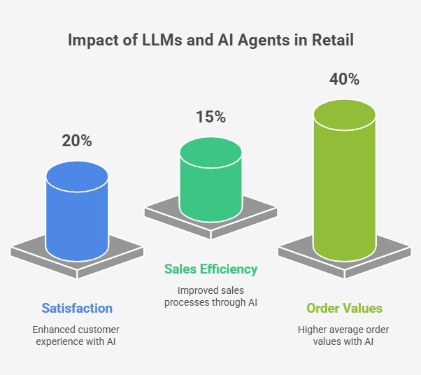
This supports the value of focusing on use cases where predictive AI can assist decision-making and improve workflow efficiency.
Step 3: Prepare and Govern Your Data for Generative AI
Strong GenAI outcomes depend on clean, structured data that stays consistent across systems. This matters because even small gaps in lineage or formatting can distort reasoning steps, weaken scoring, or raise operational risk.
That’s why we recommend you to treat data pipelines as part of your internal model governance effort.
Privacy and protection come next.
You should review how sensitive fields move across workflows and apply the security controls that limit exposure. From our experience, this protects both internal teams and downstream automation.
And access control follows the same logic. You decide who can view, edit, or feed data into prompt engineering workflows, since GenAI outputs shift based on the inputs each team provides.
A steady governance layer completes the foundation.
You should document approval paths, define validation standards, and align these rules with your organization’s broader AI governance framework. This gives you a clear way to prevent drift, reduce failure rates, and support scale without introducing new blind spots.
You can check out this short explanation on AI-ready data for a quick, clear breakdown:
Pro tip: NOVA treats data integrity as a core advantage. It gives you stable inputs that support reliable outcomes across every use case.
Step 4: Choose the Right GenAI Architecture and Model Strategy
Choosing the right architecture shapes how fast you scale and how much control you keep across your workflows. And it helps you avoid costly redesigns later.
Here are the core options we always encourage our clients to evaluate:
- Large foundation models (LLMs): Strong for broad reasoning and language-heavy tasks.
- Domain-specific models: Best when your data or regulations require a narrow focus.
- Fine-tuned models: Useful when pre-trained models lack the precision your teams need.
- Retrieval Augmented Generation (RAG): Ideal when you want grounded responses tied to approved knowledge.
- Chained reasoning workflows: Helpful when tasks require coordinated steps across GenAI processes.
So the real decision becomes where each model type aligns with your operational goals. Amazon Bedrock gives you managed access to vetted foundation models, built-in security, and predictable cost patterns across cloud infrastructure.
On the other hand, custom or open-source paths fit scenarios where you must modify internals or run model training. They also help when you need to support specialized compliance needs across generative artificial intelligence programs.
NOVA strengthens this step by using Amazon Bedrock to match your workloads with the right model and delivery pattern. And we go further by building conversational bots that run across text, voice, and video. This gives you fast, multi-channel engagement powered by LLMs without adding operational overhead.
If you’re ready to choose an architecture that scales without adding risk, partner with NOVA to build it the right way from day one.
Step 5: Build a Secure, Scalable AI Infrastructure (Cloud, Integration, Delivery)
A stable foundation matters before you place GenAI inside real workflows.
So your first step is to build a cloud architecture that supports secure integration, controlled access, and predictable performance under load. Then you can connect upstream and downstream systems so your generative artificial intelligence models work with real customer and operational data.
The practical path we recommend is: map data flows, define access boundaries, set up monitoring, and align release pipelines with compliance needs. After that, validate performance through stress tests and model validation checks to confirm accuracy, cost behavior, and response quality.
Amazon Connect and GenAI architecture make strong sense for call centers once you want automated routing, faster triage, or AI guidance for agents. Amazon Connect is the core contact center platform, and GenAI augments it with routing insights, summarization, or suggested actions, so the value compounds when you combine them.
NOVA supports this stage by configuring Amazon Connect end-to-end and layering GenAI automation on top. This gives you scalable workflows, multi-channel engagement, and operational clarity without rebuilding your stack.
Step 6: Develop a Production-Ready AI Proof of Concept (POC)
A controlled POC gives you a safe way to test GenAI workflows before they touch production systems. So, move from POC → MVP → full release because each stage reduces uncertainty, validates cost behavior, and exposes gaps in data or workflow logic.
A practical flow starts with a simple prototype, then expands into prompt design, model configuration or fine-tuning, and structured performance checks. After that, measure accuracy, response quality, and cost per interaction so you understand whether the model works under pressure.
Governance plays a major role here.
Build guardrails through human in the loop reviews, fallback actions for low-confidence outputs, and targeted risk assessments that test for unexpected behaviors, workflow gaps, or poor handoffs. This is also where you confirm that the system strengthens customer insight rather than creating new operational problems.
Pro tip: NOVA’s Activation Workshop covers scoping, conceptual design, and full POC delivery. It gives you a working environment, connected data flows, and real AI behavior you can evaluate before you advance to production.
Step 7: Launch AI Into Production, Monitor Performance, and Continuously Improve
A production launch starts with a stable CI/CD pipeline built for GenAI workloads. So your process must support safe version control for prompts, routing logic, and model configurations.
After that, you can add operational safeguards such as monitoring, drift detection, and observability checks. We advise you to do this to confirm that model behavior stays aligned with business rules and real-world conditions.
Cost control is also important at this stage. Evaluate token usage, prompt efficiency, and scaling patterns so you protect margins and revenue streams as volume grows.
And this is where results start to surface. In fact, among companies meaningfully adopting generative AI, roughly 23% reported direct revenue gains or cost reductions after deployment.
Pro tip: To maintain those gains over time, link performance to KPIs such as resolution time, agent efficiency, and customer feedback. This helps you track lift from features like AI chatbots and personalized routing while spotting friction early through data-driven cycles.
NOVA’s Production Workshop accelerates this transition by giving you a full implementation model and architectural guidance. It also provides clear steps for taking your POC into a hardened production environment.
Step 8: Measure Business Impact and AI ROI
Once your GenAI systems reach production, the next step is proving that they move the financial and operational needle. To evaluate the true impact, we encourage you to follow metrics that reflect both performance and how well the system supports your teams across the business world.
This helps you understand whether the model reduces effort and strengthens decision-making. It also shows whether it shortens product development cycles in ways that support your broader generative AI goals.
Here are the core metrics you should track:
- Savings from deflected workload and automation.
- Revenue uplift tied to better recommendations or conversions.
- Cost per interaction compared with human interaction in support channels.
- Lead conversion improvements across sales workflows.
- NPS and CSAT changes tied to faster routing or clearer answers.
- Operational throughput gains across internal teams.
- Acceleration in time-to-market for new features or workflows.
From here, compare these results with your baseline. This gives you a repeatable view of where GenAI is producing meaningful returns and where you need fresh data inputs, workflow changes, or stronger governance.
Step 9: Scale GenAI Across the Organization
Scaling GenAI doesn't mean simply adding new use cases. It means putting structure around how teams deploy, monitor, and refine AI systems across the enterprise.
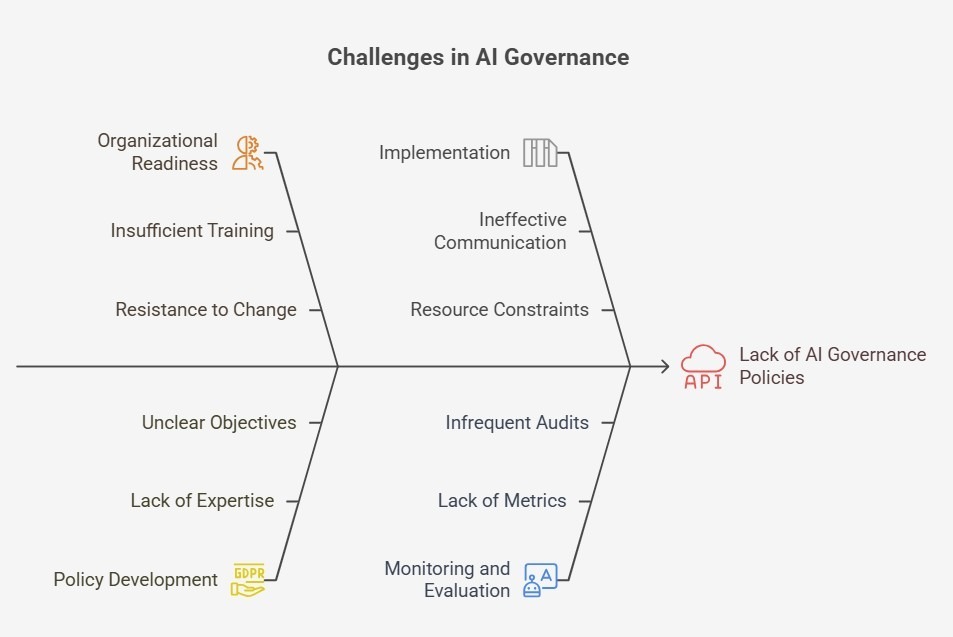
So, begin with governance, because without shared standards, risk reviews, and decision rights, adoption becomes fragmented and difficult to sustain.
And this challenge is common. In fact, only 46% of organizations have established governance policies for their AI systems. This shows how frequently scale efforts stall before they mature.
Training and enablement come next.
Teams need guidance on model behavior, workflow patterns, and when to escalate issues so your operations stay predictable as volume grows. After that, you can design a multi-team adoption strategy that defines responsibilities and integration points.
This is also where centers of excellence become valuable. They give you a structured way to centralize expertise and support shared practices across teams.
From our experience, a long-term roadmap ties everything together.
It sets sequencing, capacity planning, and technology choices while accounting for regulatory complexities and existing platforms. As your footprint grows, you also align with key ecosystem partnerships so your infrastructure, data pipelines, and governance models evolve in a coordinated way.
This creates a repeatable system for deploying GenAI across the business.
Implement generative AI the Right Way with NOVA
Implementing GenAI at scale requires a clear plan, disciplined execution, and architecture choices that match your operational goals. NOVA gives you a structured path so you can move from exploration to real business impact without losing time on avoidable missteps.
The AI Readiness Workshop helps you evaluate your architecture, data quality, and team capability. It shows gaps that limit adoption and gives you a roadmap for moving forward with confidence.
The Activation Workshop then takes you into ideation, scoping, and POC delivery. You get conceptual design, technical design, environment setup, and a working prototype built on your systems using the right models, prompts, and tools.
The Production Workshop turns your POC into a production plan with clear findings, architecture, scope, and cost estimates. It focuses on performance, reliability, and the operational behaviors your AI system must meet once deployed.
GenAI for Customer Engagement and Interaction Automation
NOVA pairs GenAI with Amazon Connect to automate call routing, triage, and agent support. And because Amazon Connect is built for omnichannel delivery, you can extend automation across voice, chat, tickets, and more.
Our Amazon Bedrock conversational bots let you reach more customers across text, voice, and even video or avatar interfaces. This gives you scalable engagement without increasing operational load.
Data Stewardship and Scalable Cloud Support
Data integrity and responsible use guide every implementation. So, NOVA evaluates your data environment, improves data flows, and makes sure your systems stay reliable as your models evolve.
We also support long-term growth with cloud engineering, DevOps acceleration, and FinOps programs. This can help you control cost and scale GenAI workloads safely.
If you're ready to move forward, contact NOVA to start building your GenAI roadmap.
FAQs
What is generative AI?
Generative AI is a technology that creates text, insights, or structured outputs based on patterns learned from data. It helps you support reasoning tasks and improve workflows across your organization.
Is generative AI the same as ChatGPT?
Generative AI is a broad category of systems, while ChatGPT is one specific model within it. So you treat ChatGPT as one tool rather than the definition of the entire field.
How to implement generative AI in eCommerce?
Implementing generative AI in eCommerce means applying it to product discovery, service automation, and personalized campaigns. It’s basically an operational layer that improves conversion, reduces effort, and optimizes decisions with natural language processing and synthetic data where needed.
How do you measure ROI after implementing generative AI?
We advise you to measure ROI by comparing savings, revenue gains, and customer-experience outcomes against your baseline metrics. Then, track how well the system reduces friction, shortens cycles, and supports your broader executive programs and planning goals.
How can NOVA help businesses implement and scale generative AI?
NOVA helps you adopt and scale generative AI through structured readiness, POC delivery, and production programs. Our workshops give you architecture, safeguards, and operational models that fit enterprise standards while reducing risk across your transformation efforts.
Comments