
Top 10 Observability Consulting Experts for Real-Time System Visibility

You already manage complex systems under constant demand. But keeping all the moving parts visible (and actionable) is getting harder by the day. That is why most teams now rely on external experts to make observability work at scale.
According to Grafana’s 2025 Observability Survey, companies use an average of eight observability technologies (down from nine in 2024), and complexity has overtaken cost as the number-one concern. That tool sprawl leads to slow incident response, disjointed observability stacks, and costly blind spots. So how do you find the right partner to bring clarity and measurable results?
In this article, you will compare leading consulting firms and see how they approach tool integration, real-time metrics, and enterprise-scale delivery. But first, let us get clear on what observability consulting really involves.
What Are Observability Consulting Services?
Observability consulting services help you make sense of what is happening across your systems by setting up the right tools, processes, and visibility layers. These services bring order to scattered data sources and fragmented signals, especially across distributed systems.
Here are the core areas covered:
- Metrics, logs, and traces (the main three pillars).
- Tooling integration (Datadog, Splunk, Grafana, etc.).
- Custom dashboards and automated reporting.
- Incident response and root cause analysis.
- Scalability planning and cost control.
- Compliance monitoring and security oversight.
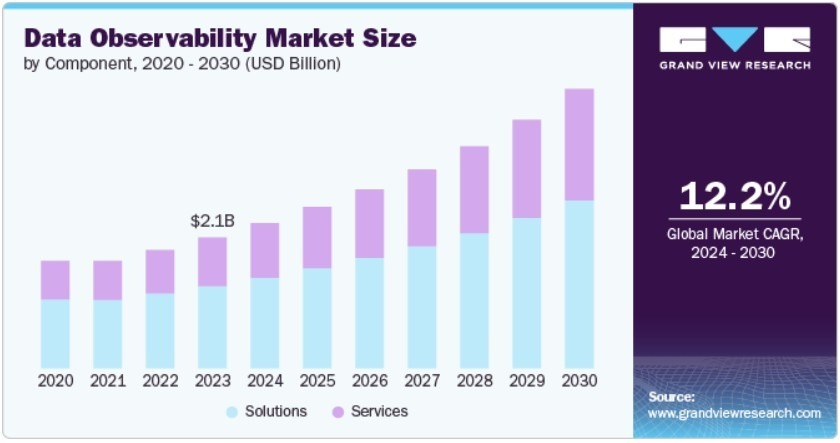
As more teams adopt containerized workloads and real-time pipelines, demand for observability consulting keeps rising. Grand View Research estimates the global observability tools and platforms market at $2.71 billion in 2023, projected to reach $5.40 billion by 2030 at a CAGR of 10.7% (Source: Grand View Research, Observability Tools and Platforms Market Report).
Source: Grand View Research
Next, let’s talk about why this matters.
Why Do You Need Observability Consulting Services?
You need observability consulting services to reduce incident noise, fix problems faster, and regain control over how your systems behave in production. For CIOs, CTOs, IT directors, and SRE leads, the challenge is visibility and building a monitoring strategy that drives action, not more dashboards.
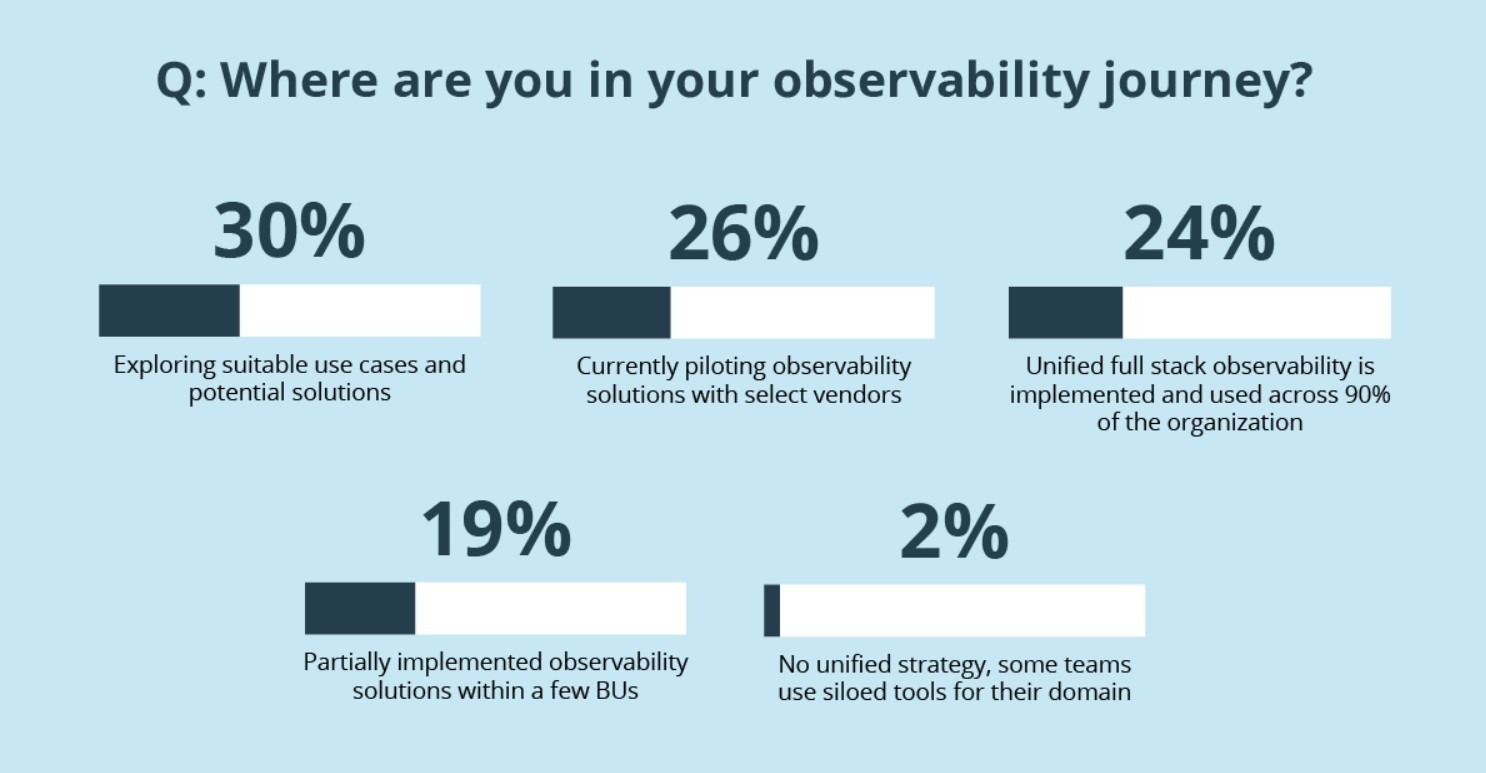
Right now, most organizations are behind. According to The State of Observability 2024 (OpsRamp), only 24% have achieved full-stack observability across 90% of their organization.
That means, in the majority of companies, outages usually spread before anyone knows where they started. And when they do hit, over 90% of mid-sized and large enterprises lose at least $300,000 per hour, based on ITIC’s 2024 Hourly Cost of Downtime report.
Source: The State of Observability 2024
You need outside help because fragmented tooling, lack of bandwidth, and siloed data make it hard to scale the right observability framework internally. Experienced partners can consolidate alerts, unify distributed tracing, and fine-tune your application performance monitoring to cut waste and tighten your feedback loops.
These are the outcomes a strong partner helps you drive:
- Faster root cause detection.
- Higher system uptime and reliability.
- Cost efficiency through tool consolidation.
- Better customer experience via reduced downtime.
- Compliance-ready visibility and reporting.
Next, let us look at who is leading this work and how they are helping teams like yours.
Top Observability Consulting Experts
NOVA, Netbuilder, InfraCloud Technologies, NoBS.tech, and others stand out as leaders in building observability at scale. These are the consulting experts helping enterprises cut downtime, unify data, and strengthen reliability.
Here are the firms you should evaluate first.
1. NOVA
NOVA gives you purpose-built observability for digital commerce and complex integration environments. Our team delivers end-to-end visibility across MuleSoft Anypoint APIs, Shopify, PayPal, and headless stacks. We do this by using tools like Datadog, Grafana, and OpenTelemetry.
You get dashboards that track both business KPIs and technical SLAs, real-time alerts that prevent revenue loss, and nearshore teams that align with your engineers for faster response.
We also help with ongoing optimization and structured incident handling. As a result, you (like all our clients) will cut downtime costs and strengthen system resilience.
You can see this in practice with Alpiq, a Swiss energy provider that struggled with five monitoring tools, poor visibility, and slow troubleshooting. NOVA helped them gain visibility over their existing MuleSoft Anypoint integrations using the Datadog Mule® Integration. We consolidated five tools into one. Our team cut the mean time to detect by 25-30% and enabled full-stack visibility across all APIs. That outcome reduced costs and gave Alpiq faster response cycles.
Key services:
- Full observability solutions with Datadog.
- Automated reporting and anomaly detection.
- Unified dashboards for metrics, logs, and traces.
- Datadog APM connector for Mule 4.
- Custom observability for Shopify and headless stacks.
- Real-time monitoring with OpenTelemetry, Grafana, and Splunk.
- Ongoing optimization, incident response, and 24/7 support.
Pros:
- Deep Datadog expertise validated by Datadog Advanced Partners status.
- Nearshore delivery for faster collaboration.
- Proven results in reducing MTTR and tool sprawl.
- Ability to embed observability in CI/CD pipelines.
Cons:
- Relying primarily on Datadog may limit flexibility for teams preferring multi-tool observability.
- Some advanced features depend on Datadog’s own roadmap.
Tier: Datadog Advanced Partners, AWS Advanced Tier Services Partner, and Salesforce Consulting Partner.
Link: NOVA Observability Consulting Services
Pro tip: If your eCommerce stack runs on Datadog, there are unique blind spots you need to close. We break this down in our guide on Datadog-powered DevOps for eCommerce systems.
2. Netbuilder
Netbuilder focuses on observability strategy and delivery across large enterprises, with expertise in platforms like Splunk, Cribl, and the ELK Stack. Its model spans consulting, implementation, training, and ongoing support.
One case study shows how the company deployed a Splunk Cloud license handling approximately 300 GB/day of ingestion. Netbuilder configured forwarders and a deployment server, ingested high-priority security data sources, and built a custom Splunk app with dashboards for security visibility. After optimizations, it cut the ADAudit log intake and reduced ingestion volume to approximately 165 GB/day. This helped its client improve detection and administration.
Key services:
- Strategic consulting aligned with business goals.
- Global project delivery with distributed consultants.
- Professional services for observability and cybersecurity lifecycle management.
- Training solutions to build in-house capability.
- Observability implementations using Cribl, Splunk, and ELK.
- Ongoing support services with monitoring and tuning.
Pros:
- Experience with large-scale log ingestion and optimization.
- Expertise in several ecosystems.
- Ability to deliver training and manage support.
Cons:
- Heavy reliance on log-based tooling may limit full-stack visibility.
- Service breadth may not provide depth in OpenTelemetry or tracing.
Tier: Cribl’s Global Professional Services Partner of the Year.
Link: Netbuilder Observability Consulting Services
3. InfraCloud Technologies
InfraCloud Technologies offers open-source observability consulting with a strong background in Kubernetes and cloud-native environments. It specializes in several observability tools to provide design, implementation, and managed support for observability stacks.
In one engagement, InfraCloud helped a B2C e-commerce business reduce observability costs by moving from Datadog to an open-source Prometheus-based setup. Its work includes handling large-scale telemetry, including pipelines that capture more than 500,000 metrics per scrape. The company also provides 24/7 managed support for ongoing monitoring and incident handling.
Key services:
- Advisory and project delivery for observability roadmaps.
- Implementation of monitoring, alerting, and distributed tracing with Prometheus, Grafana, Jaeger, and Loki.
- Centralized logging with Fluentd and long-term storage options.
- Managed services for troubleshooting and reducing MTTR.
- Training solutions for in-house engineering teams.
- 24/7 support via Slack channels for P1 and P2 issues.
Pros:
- Experience with large-scale open-source monitoring pipelines.
- Ability to reduce costs by replacing proprietary tools.
- Contributions to CNCF projects like Prometheus and Thanos.
Cons:
- Focus on open-source tooling may require higher internal ownership.
- Limited support for commercial observability platforms.
Tier: Prometheus Commercial Partner.
Link: InfraCloud Observability Consulting Services
4. NoBS.tech
NoBS.tech is a consulting firm dedicated exclusively to Datadog. It focuses on helping enterprises implement, configure, and optimize Datadog environments for observability at scale.
The firm’s delivery model focuses on speed, with engagements typically launched within a week. It also offers support designed to reduce wasted spend through optimization and cost control.
In one case, it conducted a Datadog health check for Nectar to find gaps in tagging, dashboards, and telemetry. The collaboration introduced a unified tagging strategy and optimized log pipelines. This helped the firm cut MTTR while also driving broader tool adoption.
Key services:
- Datadog implementation and environment configuration.
- Ongoing optimization and cost management.
- License reviews and budget alignment.
- Custom dashboard and alert design.
- Datadog audits and "reality checks" for efficiency gaps.
- Managed support for observability operations.
Pros:
- Exclusive focus on Datadog consulting and support.
- Fast project onboarding and delivery cycles.
- Emphasis on reducing tool and infrastructure costs.
Cons:
- Limited to a single platform ecosystem.
- No direct expertise in Grafana, Prometheus, or other tools.
Tier: Datadog Premier Partner.
Link: NoBS.tech Observability Consulting Services
5. Oreon Development
Oreon Development provides observability and SRE consulting with a specific focus on building monitoring foundations. It works with enterprises to consolidate fragmented monitoring tools into unified stacks. This can help align logging, metrics, tracing, and alerting into consistent frameworks.
The firm’s observability work usually intersects with DevOps and cloud services, covering governance, compliance, and automation.
In one healthcare SaaS project on Google Cloud, Oreon Development built a full observability stack with Prometheus, Grafana, Loki, and OpenTelemetry. The company then reduced error diagnosis time and improved alert reliability across environments.
Key services:
- Implementation of centralized logging, metrics, and distributed tracing.
- Observability audits and optimization of existing stacks.
- On-call automation and repeatable alert pipelines.
- Cloud observability setups across Google Cloud and Kubernetes.
- Governance and compliance reporting frameworks.
- Broader DevOps and CI/CD consulting services.
Pros:
- Knowledge of open-source observability tooling and pipelines.
- Ability to integrate observability with DevOps and compliance practices.
- Experience with Kubernetes-native observability.
Cons:
- Limited publicly available case studies.
- Focus on open-source tooling may not align if your organization relies on commercial platforms.
Tier: Google Cloud Partner.
Link: Oreon Observability Consulting Services
6. Mkdev
Mkdev is a European consulting firm that works in DevOps, observability, and AI/data. It can help you pick tools that fit your systems instead of pushing vendor-specific solutions. For that, they usually begin with audits and assessments to find important gaps. After this analysis, you get a clearer roadmap.
These roadmaps are delivered in a short timeframe and cover areas like scalability, security, and cost. Every project ends with full documentation and knowledge transfer so your teams can continue running the systems on their own.
Key services:
- Observability consulting, including metrics, logs, traces, and predictive monitoring.
- DevOps consulting with infrastructure as code, CI/CD, and automation.
- AI and data consulting, from concept to production-level deployments.
- Infrastructure audits and assessments with improvement roadmaps.
- Team training and mentoring to embed observability and DevOps practices.
Pros:
- Vendor independence avoids bias in tool selection.
- A mix of consulting and training that leaves internal teams prepared.
- Experience across observability, DevOps, and AI/data projects.
Cons:
- A broader scope may reduce focus on deep observability specialization.
- Limited references to partnerships with commercial observability platforms.
Tier: None.
Link: Mkdev Observability Consulting Services
7. Contino (by Cognizant)
Contino operates as part of Cognizant and delivers consulting focused on cloud-native transformation, DevOps adoption, and observability strategy. It works with regulated enterprises and large organizations that need structured approaches to modernization.
As an AWS Premier Tier Services Partner, Contino has a large team of AWS-certified engineers. Its work includes embedding observability into enterprise operating models by combining digital strategy with engineering execution.
The company typically aligns observability with security and compliance needs, especially in industries where risk management is a key driver.
Key services:
- Observability implementation using AWS services such as Amazon Managed Grafana and Amazon Managed Prometheus.
- Enterprise DevOps consulting and operating model design.
- Migration and modernization programs on AWS.
- Cloud strategy and governance frameworks with embedded monitoring practices.
- Flight Controller for Landing Zones to track business outcomes from cloud foundations.
Pros:
- Large pool of AWS-certified staff backed by Cognizant’s global resources.
- Enterprise-focused frameworks with global delivery.
- Strong alignment with AWS Professional Services.
Cons:
- Heavy reliance on AWS toolchains.
- Limited detail on support beyond initial implementation.
Tier: AWS Premier Tier Services Partner.
Link: Contino Observability Consulting Services
8. ThoughtWorks
ThoughtWorks is a global consultancy that includes observability as part of its larger platform engineering and digital transformation work. It integrates observability practices into delivery pipelines and governance models to help enterprises move from reactive monitoring to proactive detection.
The company’s approach typically ties observability to reliability, data health, and automation. Its goal is to shorten resolution times and reduce operational noise.
In one client project on AWS EKS, ThoughtWorks implemented Datadog with monitors-as-code and unified telemetry collection. This led to a solid reduction in MTTR and 80% fewer noisy alerts.
Key services:
- Building observability stacks with Datadog, Grafana, and cloud-native tools.
- Applying "observability as code" to version control dashboards and alerts.
- Autonomous observability accelerators that use AI and automation for root cause analysis.
- Data observability for pipeline health, covering freshness, lineage, and metadata tracking.
- Embedding observability into CI/CD pipelines to track release performance.
Pros:
- Integration of observability into larger delivery and governance practices.
- Experience with both infrastructure observability and data observability.
- Use of automation and AI for faster RCA.
Cons:
- Observability services are not always offered as stand-alone projects.
- Case studies typically highlight experimental approaches rather than standard playbooks.
Tier: AWS Premier Tier Services Partner, Google Cloud Premier Partner, Microsoft Solutions Partner.
Link: ThoughtWorks Observability Consulting Services
9. SoftwareMill
SoftwareMill provides consulting in observability with a focus on cost efficiency and simplification. It builds monitoring systems that work across cloud and hybrid environments, using open-source technologies such as Grafana and OpenTelemetry.
One of its strongest assets is Meerkat, an observability starter kit that gives teams a prebuilt setup for logging, metrics, and tracing. You can use it in Kubernetes or VM-based systems. The company also improves monitoring pipelines by fine-tuning ingestion, dashboards, and alerting to balance visibility with cost control.
Key services:
- Deployment of observability stacks with Grafana, OpenTelemetry, and Fluent Bit.
- Optimization of monitoring pipelines to cut ingestion costs and storage overhead.
- Development of readable dashboards for JVM and Kubernetes environments.
- Implementation of the Meerkat starter kit for rapid observability adoption.
- Integration of observability into cloud or on-premise systems.
Pros:
- Focus on cost reduction through optimized pipelines.
- Use of open-source tools with wide ecosystem support.
- Ready-to-use observability starter kit for faster adoption.
Cons:
- Open-source adoption may not fit organizations seeking certified commercial vendor support.
- Limited visibility into large-scale enterprise rollouts.
Tier: Grafana Technology Partners.
Link: SoftwareMill Observability Consulting Services
10. PSNS

PSNS is a consulting provider that combines observability, SRE, and platform engineering into structured programs. A large part of its work means helping organizations build maturity in their observability practices through assessments, enablement, and training.
Workshops are a key delivery method they use. For instance, services like "The Art of SLOs" can teach you how to set measurable objectives and then align your reliability goals with business outcomes.
PSNS can also support if your company wants to adopt Kubernetes, GitOps practices, and API management solutions. The firm works across industries such as finance, retail, energy, and travel, typically in environments built on AWS, Azure, and GCP.
Key services:
- Observability adoption and maturity assessments.
- Workshops on SLO design, service reliability, and best practices.
- Site Reliability Engineering (SRE) consulting and enablement.
- Kubernetes and GitOps consulting (e.g., ArgoCD, GitLab, GitHub).
- API management with Apigee and Solo.io.
Pros:
- Focus on workshops and training.
- Coverage across cloud platforms (AWS, Azure, GCP).
- Multi-industry experience.
Cons:
- Focusing on workshops may mean less emphasis on hands-on implementation.
- Limited detail on long-term managed services.
Tier: Not specified.
Link: PSNS Observability Consulting Services
How to Choose Observability Consulting Partners
Choosing an observability consulting partner means considering whether they can work alongside your internal teams. They also need to reduce complexity in your stack and deliver measurable outcomes across availability, cost, and compliance.
The wrong choice leads to missed signals, extended MTTR, and rising overhead. But the right one gives you faster decisions and stronger control.
Before signing a contract, you need to evaluate how each vendor performs in both technical depth and delivery model. Look beyond case studies and ask about their specific experience with your tool architecture, internal processes, and reporting needs.
These are the key factors you should evaluate:
- Tool partnerships and certifications: Look for credentials like Datadog Premier or Advanced Partners, AWS Premier Tier Services Partner, or Grafana Technology Partner to confirm hands-on experience with major observability platforms.
- Industry experience and client case studies: Review examples tied to your infrastructure scale, especially those showing improvements in uptime, real-time monitoring, or issue detection.
- Support model: Confirm they offer true support services, including 24/7 monitoring, fast incident response, and clearly defined escalation paths.
- Scalability and global reach vs. boutique delivery: Understand if they can scale with you across regions and time zones or if they focus on smaller project scopes.
- Pricing transparency and FinOps practices: Ask how they handle license optimization, ongoing tool costs, and whether they align with your internal budget guardrails.
- Security and compliance coverage: Check for clear practices around SOC2, HIPAA, PCI, and how they help your security teams manage alerts and visibility.
A solid consulting partner helps you implement tools. They also strengthen how your teams work, respond, and report across the board.
Pro tip: Choosing between agencies can be overwhelming. To help, we put together a list of the 10 best observability and APM agencies for enterprise eCommerce teams.
Where to Focus Next for Better Observability Results
Improving observability means cutting incident costs, speeding up issue resolution, and protecting uptime across all environments. That is why your consulting partner needs proven expertise in building scalable observability pipeline architectures that match your systems and business goals.
NOVA helps you do exactly that. As an Advanced Datadog Partner, we bring deep platform knowledge, custom integrations, and focused delivery that drives outcomes.
Schedule a call with our team to see how NOVA can help you move faster and fix smarter.
FAQs
What is observability consulting?
Observability consulting helps you build or improve the way your teams capture, analyze, and act on signals from your systems. It covers metrics, logs, traces, and related processes so that you can link technical events to business outcomes and reduce blind spots across your infrastructure.
How does observability differ from monitoring?
Monitoring alerts you when something breaks. Observability gives you the context to understand why it broke. Monitoring is rule-based and reactive, while observability gives you the flexibility to investigate unknown issues.
Which tools are most commonly used for observability?
Commonly used tools include Datadog for full-stack monitoring, Grafana for dashboards, OpenTelemetry for data collection, Prometheus for metrics, and Splunk for log management. These tools help unify infrastructure, application, and business metrics into one view.
How much do observability consulting services cost?
Costs vary with scale, data ingestion, and tool choice. According to a widely cited estimate by Honeycomb’s Charity Majors, quality observability typically represents 15-25% of an infrastructure bill (note: this is an informal industry benchmark, not formal research). The 2025 Grafana Labs Observability Survey found that observability spend averages approximately 17% of total compute infrastructure spend. Going below that range is possible, but it usually means cutting back on visibility or coverage.
Why choose NOVA over larger consulting firms?
With NOVA, you work with an Advanced Datadog Partner that delivers specialized implementations rather than generic frameworks. Our model focuses on Datadog expertise, MuleSoft integrations, and hands-on delivery over long advisory cycles. That means you get measurable outcomes (like lower MTTR and cost savings) without the overhead of a large consultancy.
Comments