
Top 10 Gen AI Call Center Companies Revolutionizing Customer Service

Executive Summary
- Enterprise call centers are adopting GenAI to control rising call volumes, agent burnout, and inconsistent service quality across voice and digital channels.
- GenAI call center platforms vary widely in where they apply automation, how they support agents in live calls, and how reliably they operate under real traffic.
- Key differences across vendors emerge in voice latency, escalation logic, CRM context handling, compliance controls, and cost predictability at scale.
- Choosing the wrong approach or architecture introduces new risks, including inaccurate responses, broken handoffs, and limited operational visibility.
- NOVA addresses these gaps by supporting the design and deployment of GenAI call center systems that integrate cleanly with existing infrastructure and behave predictably in production
If your call center is under pressure from rising volumes and slow resolution, contact NOVA to help you operationalize generative AI in your live contact center environments without disrupting your existing systems.
***
Rising call volumes, slow resolutions, and uneven service make it hard to keep pace. This is especially true as customer expectations grow faster than your team can respond.
Agents lose time digging for context, and burnout rises when repetitive work crowds out real problem-solving. So, you might be in need of generative AI call centre companies that can help steady the load and improve operational control.
In this guide, you’ll compare the top 10 leading platforms and see which ones deliver real gains. You’ll also spot the tradeoffs that matter.
Let's get started!
What Are GenAI Call Center Companies?
GenAI call center companies are:
- Platforms (e.g. CCaaS / AI layers)
- Infrastructure providers
- Tool vendors
- Or service integrators (like NOVA)
They apply large language models to support automation and agent-assisted workflows across the contact center, both for customers and agents. They can help with routine requests, assist with complex conversations, and surface context in real time through agent assist, sentiment analysis, and call routing.
GenAI is in demand now more than ever. According to Cresta’s 2024 agent survey, 65% of agents want real-time AI help on calls, while 81% say AI support improves confidence when shifting from service to sales. That shift to GenAI can change your conversion outcomes.
There are more reasons why GenAI call center companies matter. That leads us to our next point.
Why GenAI Call Center Providers Matter for Enterprises
Running service at scale creates pressure across cost, speed, and consistency. When implemented correctly, GenAI can help enterprises address rising volumes, cost pressure, and service inconsistency. When implemented poorly, it introduces new friction, inaccurate responses, and broken handoffs.
So here are the core reasons good providers can make or break real operations:
- Reduce operating costs: Well-designed automation helps absorb repeat requests that inflate staffing needs. With AI-driven automation handling predictable work, budgets shift from coverage to improvement rather than constant hiring and training.
- Improve CSAT: Faster answers and consistent responses shape how customers judge every interaction. Strong customer experience depends less on which agent answers and more on shared logic and context. Good Gen AI call center companies can help you implement a solid system.
- Automate Tier-1 support: Simple questions no longer queue for humans. As a result, virtual agents assist with balance checks, order status, and basic troubleshooting so teams focus on higher-value work.
- Boost agent productivity: Effective platforms and implementations reduce the time agents spend searching across systems. With real-time prompts and summaries, they stay focused on the conversation instead of the interface.
- Reduce call handling time: AIPRM’s 2024 data shows expectations for first response and resolution speed rose by over 50%. This pushes teams to rely on AI-powered tools to keep pace. Well, capable GenAI solutions help teams move faster without sacrificing service quality.
- Improve quality insights: Conversation data surfaces patterns that your teams can act on. That improves coaching, forecasting, and long-term planning.
These are just a few ways generative AI is applied in call centers by solid providers. Many teams follow similar contact center adoption trends as they scale automation and reduce cost pressure.
But here are five more capabilities that you should know:
Now, let’s move on to how the top platforms were selected.
How We Selected the Top 10 GenAI Call Center Companies
Choosing the right platforms requires more than feature lists. The focus stays on how each option performs under real pressure and how it fits enterprise constraints.
Here are the criteria used to evaluate this list:
- Model sophistication: Strong results depend on how artificial intelligence is applied in production. Platforms stood out when their models supported long conversations, adapted to context, and applied natural language processing without breaking flow or accuracy.
- Omni-channel support: Customer conversations rarely stay in one place. Gen AI call center companies earned their spot when multichannel support stayed consistent across voice, chat, and email instead of fragmenting answers.
- Integration with CRMs: Context drives speed. Deep CRM integrations mattered because agents rely on current records rather than partial snapshots pulled from disconnected tools.
- Scalability: Enterprise traffic rises without warning during traffic spikes, which makes cloud scalability a deciding factor during peak demand. So, vendors were evaluated on how well their systems support consistent response quality and scale during spikes.
- Security and compliance: Trust comes from clear controls. And platforms needed clear data handling practices, access controls, and audit paths that align with regulated environments.
- Real-world case studies: Claims matter less than outcomes. Hence, preference went to vendors showing measurable improvements in live deployments.
Pro tip: Are your customer support systems ready to handle retail traffic spikes across voice, chat, and post-purchase support? If not, you can compare how teams approach this in our GenAI eCommerce development guide across retail environments.
With all of this out of the way, let’s move on and compare the companies that made the list.
Top 10 GenAI Call Center Companies
The top GenAI call center companies are NOVA, AI Superior, Cresta, VoiceSpin, C3, and others. These platforms differ based on how they perform in live environments and where they fit enterprise needs.
Here are all of the companies worth examining more closely, starting with the leaders and moving through the broader field.
1. NOVA
NOVA supports the design and deployment of GenAI contact center systems that run in production. You work with us when you need real control over how AI systems perform across voice and messaging channels, especially with Amazon Connect and generative AI.
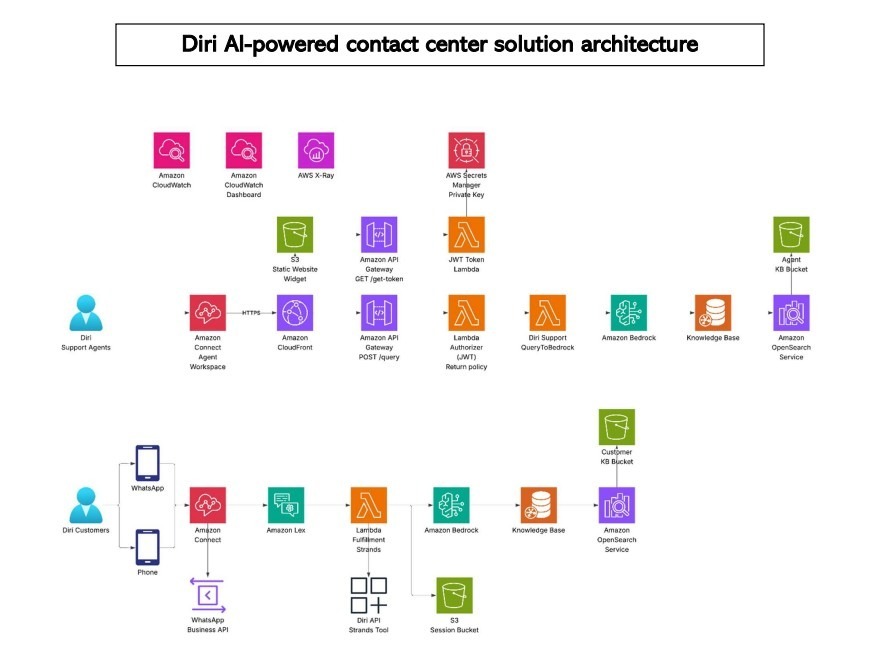
Our team at NOVA designs serverless architectures on AWS using Amazon Bedrock, Amazon Lex, Lambda, and retrieval-based knowledge layers. We do this so that routine issues can be addressed automatically while complex cases are routed to human agents at the appropriate moment.
And this focus shows up in live results.
In a telecom deployment for Diri, we helped the company reduce customer wait times from 43-80 minutes to near-immediate response. Meanwhile, our team redirected agent capacity away from repetitive Tier-1 calls and into higher-value interactions that require judgment and empathy.
If you want similar results for your contact center, NOVA can support your contact center implementation!
Pros:
- Deep Amazon Connect integration without replacing existing infrastructure.
- Dual knowledge bases for customers and agents, which improve accuracy under load.
- Real-time sentiment detection that supports clean human handoffs.
- Serverless model that scales with demand and stabilizes cost.
Cons:
- AWS alignment to realize the full value is needed.
- Implementation partner rather than a self-serve SaaS tool.
Website: novacloud.io
2. AI Superior
AI Superior is a Germany-based AI services firm founded in 2019 that builds custom voice and speech systems for enterprise use. Its work typically centers on conversational AI, speech recognition, text-to-speech, and voice bots that plug into existing call center solutions.
Also, delivery follows a project-based model, with a focus on data preparation, model selection, and controlled rollout rather than packaged products. In practice, this approach fits teams that want custom speech pipelines instead of prebuilt platforms.
Pros:
- Custom voice and speech system development aligned to specific workflows.
- Coverage across speech recognition, synthesis, and interactive voice response.
- Project-led delivery with defined scopes and milestones.
- Support for language expansion and audio data processing.
Cons:
- Longer time to value compared to preconfigured platforms.
- Ongoing maintenance tied to custom-built components.
- Limited out-of-the-box analytics for large-scale operations. Analytics are implemented via external tools.
Website: aisuperior.com
3. Cresta
Cresta is an enterprise platform built for applying generative AI inside contact centers. The system combines an automated AI assistant for routine interactions with real-time guidance for agents during live calls.
At the same time, speech analytics reviews conversations across voice and chat to surface patterns tied to coaching and quality assurance. Deployment typically connects with existing CRM systems, which keep context available during handoffs and follow-ups.
The company applied this approach in several financial services environments. In one deployment, the platform supported broader self-service coverage. Meanwhile, it gave supervisors visibility into agent behavior across channels.
Pros:
- Real-time agent guidance tied to live conversations.
- Automated quality monitoring across all interactions.
- Centralized operations view for human and AI activity.
- Integration support for common contact center stacks.
Cons:
- Some users report heavier dependence on upstream systems.
- Keyword-based AI setup can be manual.
- Users must define triggers, so the risk of false positives increases.
- Platform focus centers more on guidance than full workflow ownership. However, Cresta’s platform includes multiple modules capable of supporting workflows end‑to‑end.
Website: cresta.com
4. VoiceSpin
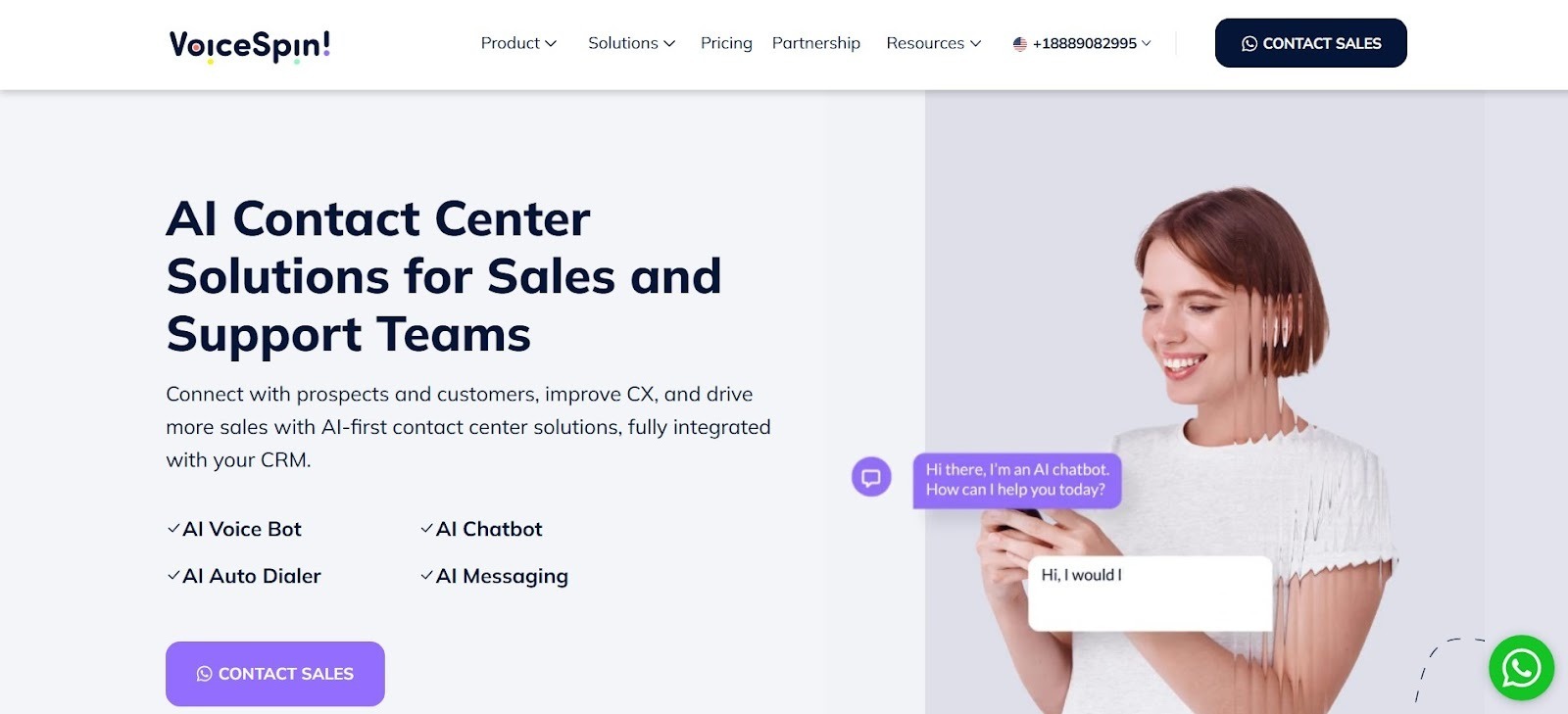
VoiceSpin is a cloud-based platform that combines outbound and inbound automation for sales and support operations. The system includes virtual assistants for voice and chat, predictive dialing for outbound campaigns, and routing logic that manages inbound requests across channels.
Meanwhile, it has speech monitoring that tracks tone and keywords during live calls to feed structured customer data back into connected systems. This setup usually appears in environments where outbound volume and speed matter as much as inbound coverage.
In one case study, VoiceSpin automated dialing and call timing. That changed how agents engaged leads and supported higher throughput across daily campaigns.
Pros:
- Inbound and outbound automation in a single platform.
- Predictive dialing paired with real-time call routing.
- CRM connectivity for syncing CRM data and call records.
- Speech analysis for monitoring agent-customer interactions.
Cons:
- Platform emphasis leans more toward sales motion than complex service workflows.
- Automation depth varies by channel and use case.
- Orchestration across backend systems remains limited compared to full architectural builds.
Website: voicespin.com
5. C3
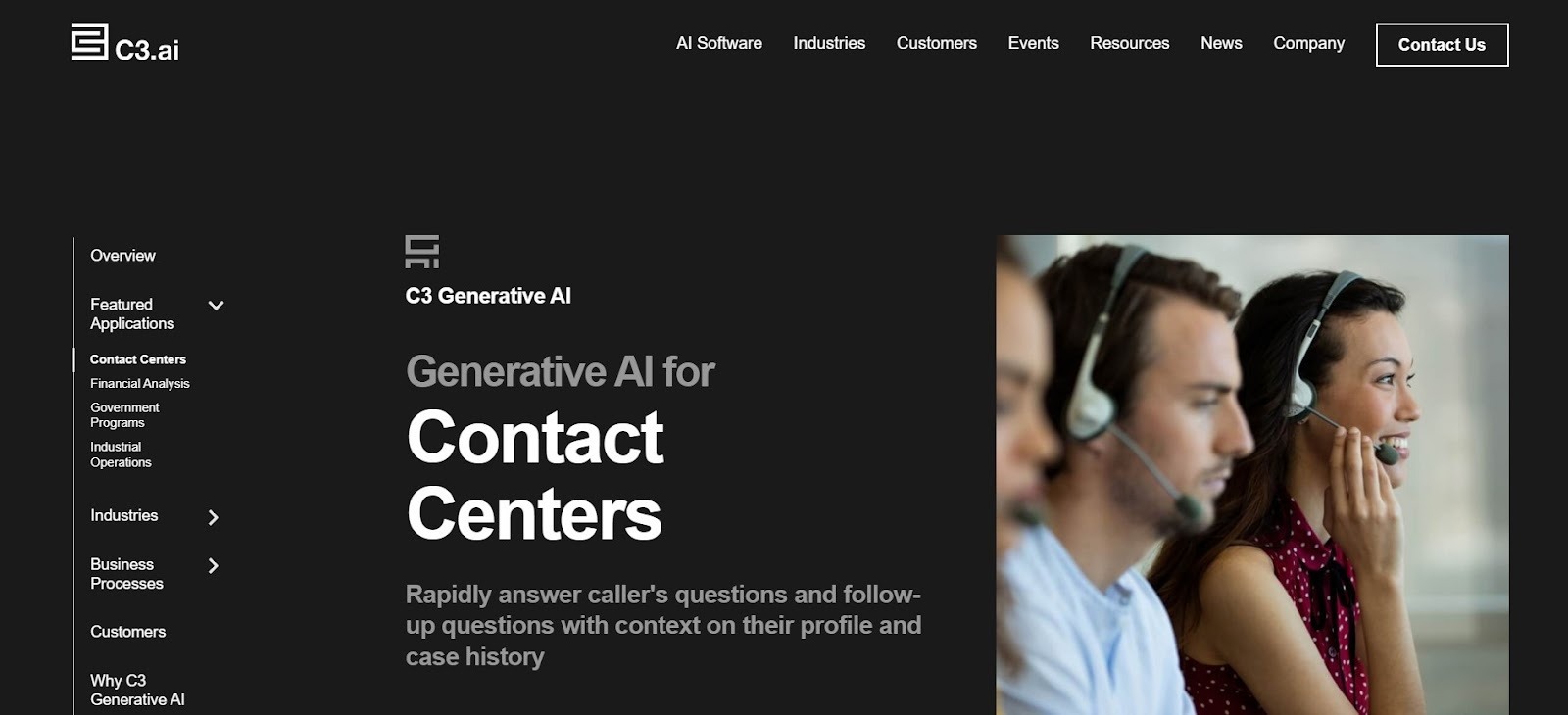
C3.ai applies generative AI across large operational systems, including customer support environments. For contact centers, the company provides packaged applications that apply natural language models to answer questions using customer interaction histories and enterprise data sources.
The system relies on agent-based orchestration to retrieve records, reason across documents, and return grounded responses inside existing CX stacks (if that’s how you integrate the platform). Governance and validation layers sit alongside this logic to support controlled use in various enterprise environments, including regulated settings.
C3 once supported a global financial services organization by shortening the time agents spent searching internal systems for information. This changed how cases were handled during live support sessions, because the agents could focus on support rather than research.
Pros:
- Enterprise-grade AI customer support software.
- Agent-based orchestration across multiple internal systems.
- Grounded responses using enterprise content and knowledge base answers.
- Built-in monitoring and controls for regulated workflows.
Cons:
- Platform breadth introduces setup and configuration overhead.
- Contact center use cases depend on broader enterprise data integration and readiness.
- Real-time experiences rely on upstream system performance rather than built-in telephony logic.
Website: c3.ai
If you need predictable GenAI behavior inside Amazon Connect, contact NOVA to automate Tier-1 calls, guide agents in real time, and keep service consistent as demand scales.
6. Replicant
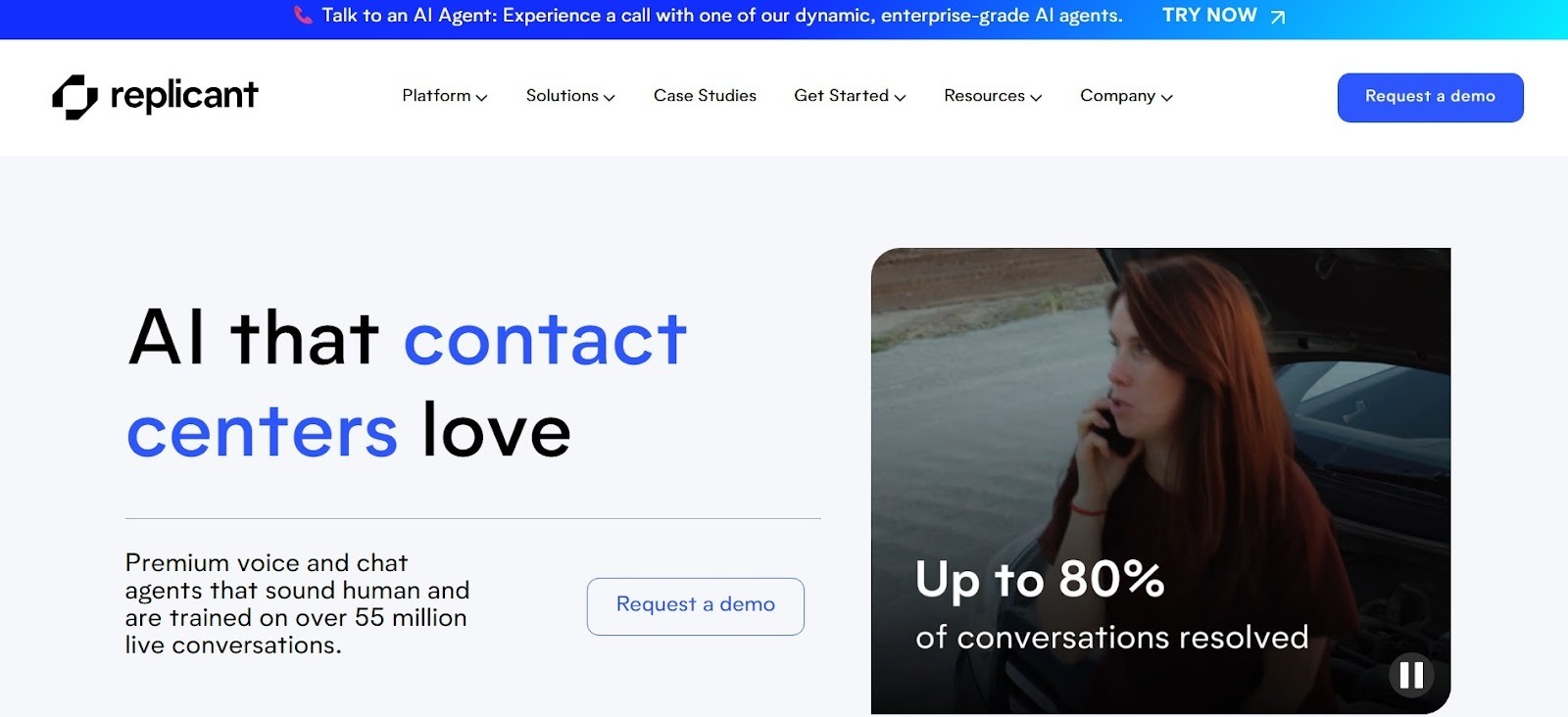
Replicant provides a conversational AI platform built for voice and chat automation in contact centers. The system uses AI agents trained on large volumes of platform and customer interaction data (including historical conversations) to handle routine requests. It can also transfer calls to humans based on intent or context.
Voice and chat agents operate without fixed scripts and rely on conversation history to guide responses.
For example, Replicant once automated a large share of payment-related calls for an enterprise support team. This changed how agents allocated time across routine and complex cases.
Alongside automation, the platform provides conversation intelligence and QA analytics to support monitoring and review workflows.
Pros:
- Voice and chat automation designed for high call volumes.
- Script-free conversation handling based on historical data.
- Full interaction recording with built-in analysis.
- Subscription-based usage model that removes per-call limits.
Cons:
- Conversation control depends heavily on prior training data quality.
- Customization outside supported use cases requires vendor involvement.
- Native orchestration across backend systems remains limited.
Website: replicant.com
7. Avaya
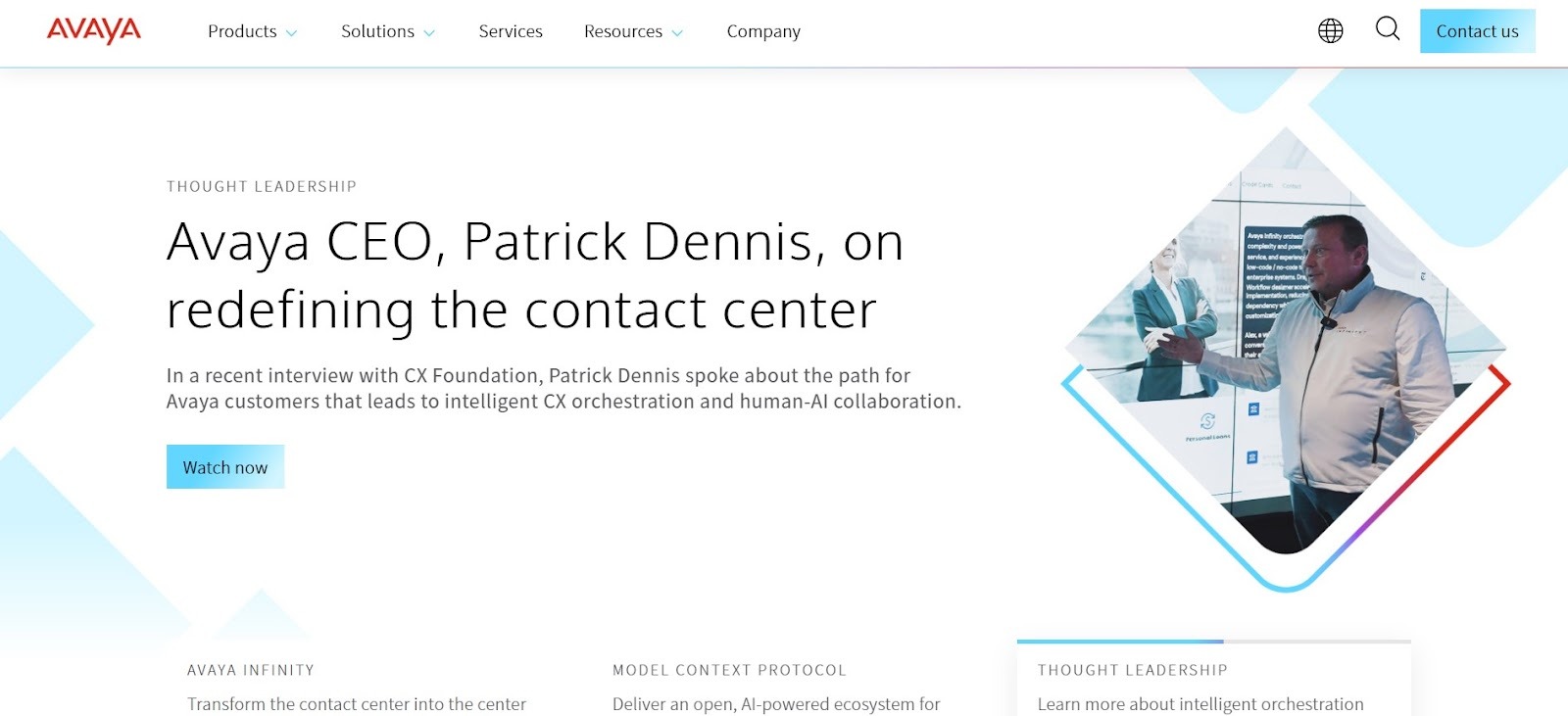
Avaya is a long-standing enterprise communications vendor with a contact center platform that now supports AI-driven orchestration. The Avaya Infinity Platform brings voice, digital channels, and routing into a single environment that runs in cloud, on-prem, or hybrid setups.
AI integration happens through AI‑agnostic orchestration layers that let enterprises include multiple models and partner tools inside existing call flows. Virtual agents, IVR, recording, and performance monitoring remain part of the same system, which keeps legacy operations intact while adding automation paths.
As such, in one case study, Avaya expanded the automated call handling of a public-sector healthcare operation. This reduced the share of interactions reaching live agents while maintaining service continuity.
Pros:
- Unified platform for voice and digital channels.
- Hybrid deployment options for legacy environments.
- AI‑agnostic integration through orchestration layers that support multiple models.
- Built-in recording and performance management tools.
Cons:
- Core architecture reflects legacy contact center design choices.
- AI capabilities rely heavily on integration with external AI models and partner technologies.
- Platform changes typically require structured migration planning.
Website: avaya.com
8. Level AI
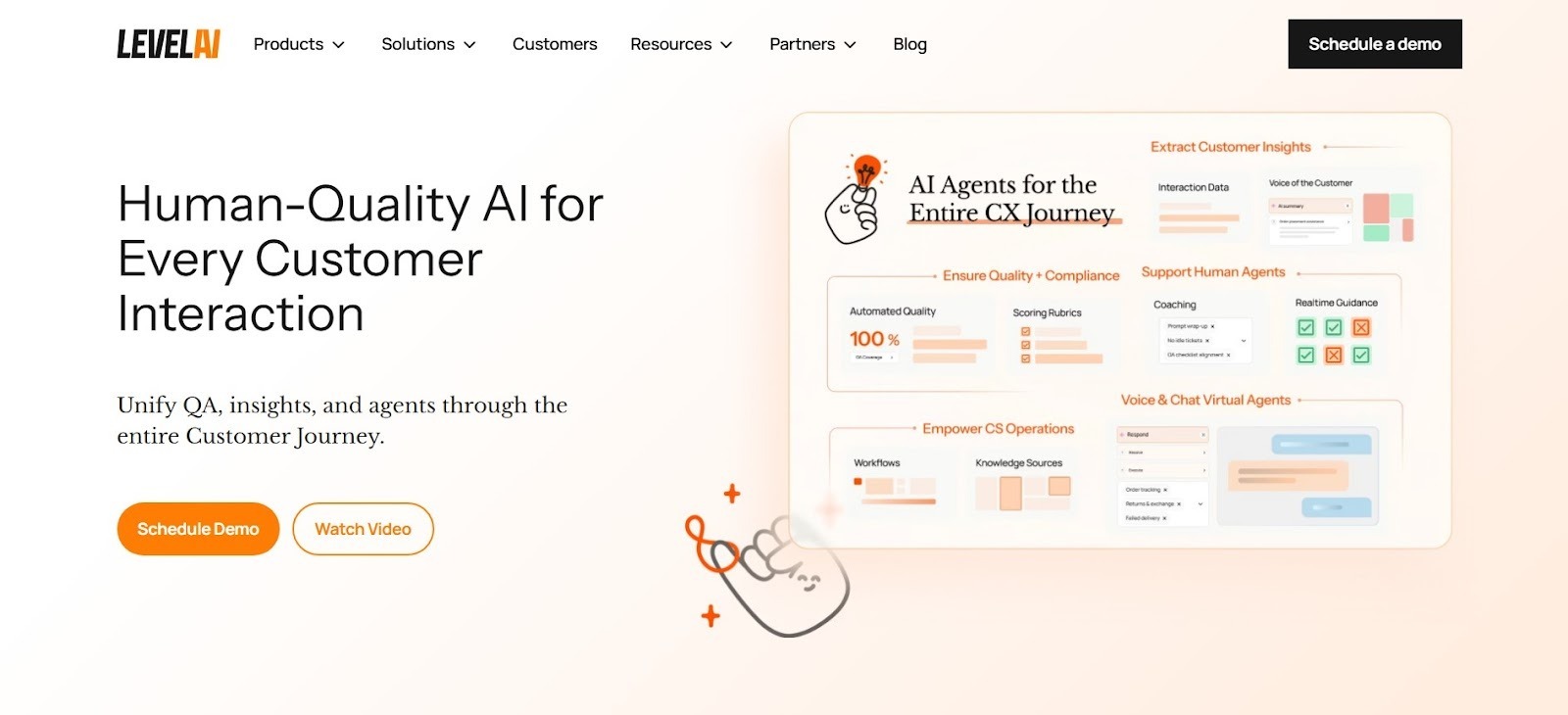
Level AI is focused on conversation analysis and automated quality workflows inside contact centers. The system applies generative and semantic intelligence models to review voice, chat, and email interactions against predefined scorecards and policies.
Call scoring, disposition tagging, and sentiment tracking run continuously across recorded conversations rather than sampled sets. At the same time, real-time insights surface during live calls to guide responses and capture outcomes for reporting.
For example, Level AI once automated quality review and coaching workflows for a large support organization. This changed how audits and performance feedback were handled across teams.
Pros:
- Automated scoring across all recorded interactions.
- Real-time assistance and insight layered onto live conversations.
- Centralized analytics for coaching and review workflows.
- Support for voice, chat, and email analysis.
Cons:
- Platform scope centers on quality and insight rather than full automation.
- Real-time guidance depends on clean scoring definitions and tuning.
- Not intended as a full contact‑center orchestration or routing solution; functionality centers on QA and insights.
Website: thelevel.ai
9. Observe AI
Observe AI centers on speech analysis, transcription, and agent coaching inside contact centers. It applies multi‑model AI (including contact-center-trained language models) to review calls, generate summaries, and surface guidance during live conversations.
Quality review runs across recorded interactions rather than samples, while post-call analysis feeds dashboards used for coaching and operational review. Knowledge retrieval via Knowledge AI pulls answers from internal documents and policies during live sessions, which keeps responses aligned with internal rules.
Observe AI supported an insurance provider by automating quality review and coaching workflows. This changed how quickly leadership identified issues and adjusted service processes.
Pros:
- Automated analysis applied across all recorded interactions.
- Real-time prompts and guidance surfaced during live calls.
- Post-call summaries generated without manual input.
- Knowledge retrieval across internal documents and policies.
Cons:
- Platform focus centers on analytics and coaching rather than automation ownership.
- Real-time guidance depends on appropriate configuration and tuning to avoid interruption during calls.
- Call flow and routing logic remain dependent on external systems.
Website: observe.ai
10. Qualtrics
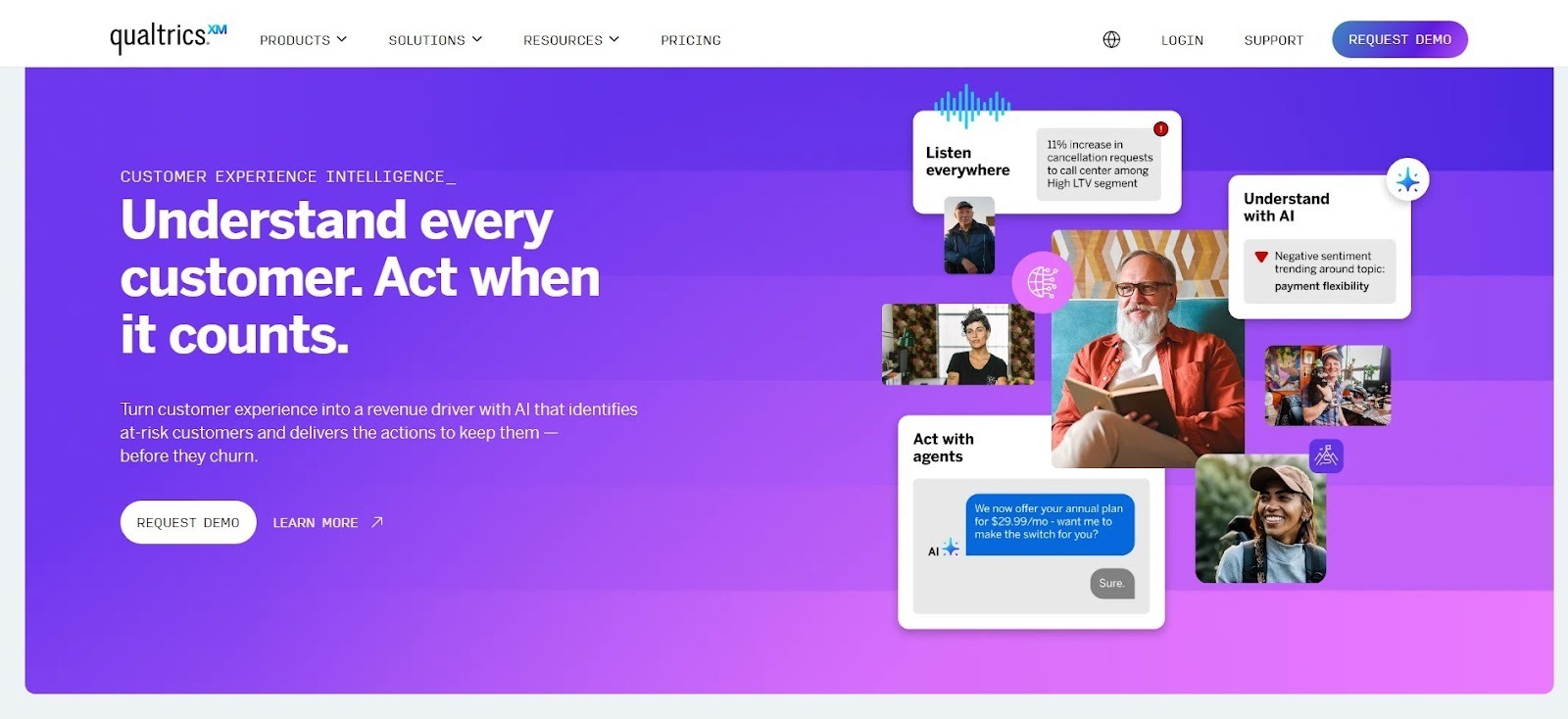
Qualtrics operates an experience management platform that extends into contact center environments through analytics and workflow automation. The system ingests interaction data from voice, chat, email, and surveys. Then it applies AI models to score sentiment, compliance, and effort across every conversation.
Insight layers sit above this data. In fact, Qualtrics Assist and related analytics let users query and explore interaction data with AI. Also, automated workflows trigger follow-up actions based on predefined thresholds, which link contact center activity to broader experience metrics.
The platform focuses on measurement, analysis, and response orchestration rather than direct call handling or routing.
Pros:
- Centralized analysis across interaction and survey data.
- Automated AI‑driven scoring applied to all captured interactions.
- Workflow triggers based on experience thresholds.
- Broad integration coverage across contact center stacks.
Cons:
- Platform focus centers on insight and measurement rather than live automation.
- Real-time control over call flows remains external because Qualtrics focuses on analytics and experience orchestration.
- Operational impact depends on downstream process execution.
Website: qualtrics.com
How to Choose the Right GenAI Call Center Provider
Selecting a provider shapes how automation fits into daily operations and long-term plans. Here are the factors that matter most once vendor shortlists start to look similar:
- Level of automation vs human-assist: Some platforms focus on end-to-end call automation, while others support agents during live conversations. The choice affects risk tolerance, escalation paths, and how much control remains with human teams.
- Integration with Amazon Connect, Zendesk, Salesforce: Tight integration determines whether context flows cleanly across systems or fragments during handoffs. Weak links slow resolution and increase manual work.
- Data privacy: Data handling rules define where models run, how transcripts are stored, and who can access them. This directly affects regulated environments and audit readiness.
- Cost structures: Pricing models influence predictability under volume spikes. Usage-based designs behave very differently from flat or infrastructure-led models.
- Multilingual support: Language coverage affects rollout scope and consistency across regions, not just translation quality.
Pro tip: You need to prevent AI-generated responses from drifting when policies, knowledge bases, or CRM data change. How do you do that? Our guide explains how retrieval-augmented generation on AWS Bedrock helps keep responses grounded in your own data.
Next, it makes sense to look at the challenges teams face during adoption.
Common Challenges With GenAI Call Center Adoption
Rolling out GenAI changes how service teams work, but gaps appear fast when foundations are weak. So here are the issues that most often slow progress once pilots move into production:
1. Hallucinations.
AI models can produce confident but incorrect answers when context is missing or poorly grounded. That risk grows in complex cases and forces rework or escalations.
2. Poor data hygiene.
Outdated policies, conflicting records, or incomplete histories feed bad inputs into the system. As a result, responses drift and trust erodes across teams.
3. Legacy CRM integration.
Older systems typically limit real-time data access. This breaks context sharing and forces agents to verify information manually during live calls.
4. Regulatory concerns.
Data residency, retention rules, and audit trails require tight controls. Without them, rollout stalls in regulated environments.
5. Need for human oversight.
Automation still requires review paths, escalation logic, and ownership. Without clear guardrails, errors can compound instead of resolving.
Ready to Choose the Right GenAI Call Center Platform for Enterprise Scale?
Across this list, the differences come down to ownership boundaries, operational control, and how AI systems perform under real pressure. Some platforms optimize parts of the workflow, while others influence how calls move, how agents work, and how data stays consistent.
Those tradeoffs affect cost, risk, and service quality over time. So the right choice depends on how much automation you want, how complex your stack already is, and how much control your team needs in production.
If you’re aiming to support systems designed around real call volumes and enterprise constraints, NOVA is the place to start the conversation. Contact us today to learn more.
FAQs
Why use generative AI in call centers?
Generative AI is used in call centers because it supports routine work at scale while keeping responses consistent. As a result, teams spend less time on repetition and more time on complex customer issues.
Is GenAI safe for customer service?
GenAI is safe for customer service when controls like grounding, logging, and human review are in place. Without those safeguards, risk increases through incorrect responses and compliance gaps.
What are generative AI use cases for call centers?
Generative AI is used for call automation, agent assistance, summaries, quality review, and knowledge retrieval. According to McKinesey, this can reduce manual effort by up to 50% across the interaction lifecycle.
Does GenAI replace call center agents?
GenAI does not replace call center agents because human judgment is still required for complex and sensitive cases. Instead, automation can shift agent effort away from repetitive work and into higher-value interactions.
Comments