How to Optimize Cloud Strategies with DevOps: Steps, Tools & Best Practices

Executive Summary
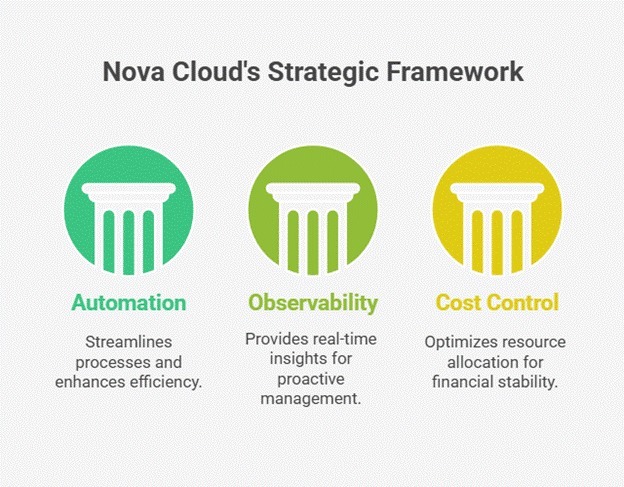
Your cloud investments can’t deliver predictable results without DevOps at the core. So, you need automation that cuts waste, visibility that prevents downtime, and governance that scales with compliance.
Here’s the quick view:
-
- Reduce cloud spend by right-sizing infrastructure and tuning observability costs.
- Improve uptime through automated rollbacks and smarter CI/CD monitoring.
- Strengthen governance with audit-ready pipelines and embedded security controls.
If you’re ready to make your cloud strategy measurable and efficient, book a demo with NOVA to see how our AWS and Datadog teams can help you do it right.
***
Your cloud strategy doesn’t fail because of bad tools. It fails because your teams don’t spend enough time on improving.
Every delay in a release, every spike in cloud costs, every missing alert adds friction you can’t afford. And let's be honest, you’ve probably invested in automation, but automation alone doesn’t guarantee stability or predictability.
That’s where DevOps practices change the equation. Disciplined automation and observability give you control over spend, faster recovery after failures, and consistent reliability across complex systems.
In this article, you’ll learn how to strengthen your cloud strategy and see where NOVA makes a difference. Let's get started!
What Is DevOps in Cloud Strategy?
DevOps in cloud strategy means using automation, observability, and collaboration to make your cloud infrastructure predictable, scalable, and secure.
AWS handles the heavy lifting of compute and scaling, while DevOps drives consistency through CI/CD pipelines, testing, and monitoring. Together, they turn your cloud setup into a measurable system that adapts and improves with every release.
That combination is proven to work. A cloud-using DevOps team (public or hybrid cloud) is about 14% more likely to meet or exceed performance goals than teams not using the cloud.
Also, you can see how AWS and DevOps work together in this quick video:
Why You Need DevOps to Optimize Your Cloud Strategy
You need DevOps to turn your cloud optimization plan into something predictable, cost-aware, and stable. Without it, cloud services expand faster than your team can manage, and that leads to ballooning costs, tool sprawl, and unplanned downtime.
With DevOps, you get automated CI/CD pipelines, blue/green deployments, and proactive monitoring that keep your environment reliable and repeatable. Here’s how the impact shows up across roles:
- CFO: Wasted spend from poor scaling and limited observability.
- CTO: Release delays and inconsistent cloud resources.
- Ops leader: Firefighting incidents instead of preventing them.
NOVA solves this by combining AWS and Datadog expertise. We’re an AWS Advanced Partner and Datadog Gold Partner, so we can align infrastructure, observability, and cost control. This keeps your systems predictable and your operations measurable.
Key Components of Cloud Strategy with DevOps
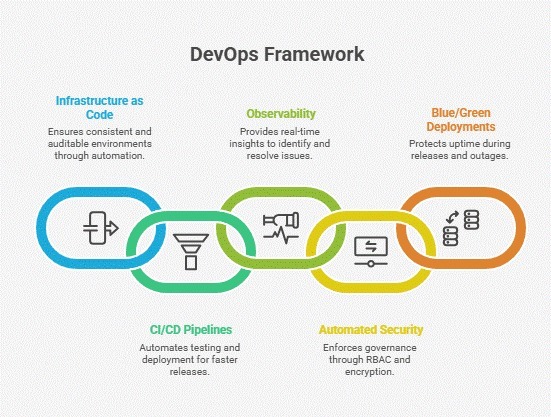
A strong DevOps approach keeps your cloud platforms stable, secure, and measurable. The real advantage comes from integrating automation, observability, and control into every layer of your cloud-based DevOps infrastructure.
These are the key components that make it work in practice:
- Infrastructure as Code, using tools like AWS CloudFormation and Terraform, keeps every environment consistent and auditable.
- CI/CD pipelines with AWS CodePipeline, Jenkins, or GitHub Actions automate testing, validation, and deployment for faster releases.
- Observability as a first-class element powered by Datadog brings logs, traces, and metrics together to identify issues before they affect users.
- Automated security and compliance ensure governance through RBAC, audit trails, and encryption at every layer.
- Blue/green deployments and disaster recovery protect uptime during releases and outages.
NOVA’s AWS and Datadog-certified teams apply these principles daily. We can help you connect automation and observability so your systems stay reliable, predictable, and ready to scale.
How to Optimize Cloud Strategies with DevOps
A strong DevOps model makes your cloud cost optimization plan strategic. Instead of chasing problems after they happen, you build automation and observability into the way your systems run.
These are the core areas where DevOps delivers measurable impact.
Cost Optimization
The biggest wins usually start with smarter scaling and resource control. DevOps brings automation to cost management by using autoscaling, serverless computing, and spot instances to match capacity with actual demand. This reduces idle time and keeps resource utilization efficient.
Take Gopanza, for example. Moving workloads to AWS RDS allowed the company to achieve a 50% reduction in costs compared to Azure because AWS RDS can more easily adapt to ecommerce traffic fluctuations.
That’s the kind of precision NOVA can help you, too, obtain, scaling performance while cutting spend.
And when you build with cost awareness baked in, DevOps becomes the system of checks that helps finance and engineering stay aligned on usage and spend.
Performance Optimization
Container orchestration makes all the difference for speed and consistency. Platforms like Amazon EKS or ECS help you deploy microservices quickly and manage them at scale. DevOps ties these container systems with continuous integration and observability pipelines to maintain visibility throughout the software development life cycle.
Jaguar Land Rover saw this firsthand. The company migrated to Amazon EKS and saw its build-pipeline setup time drop by 95%. That kind of gain happens when automation, orchestration, and observability work together.
Reliability Optimization
When every minute of downtime costs revenue, recovery speed becomes a competitive edge. DevOps gives you the framework to tie observability data to recovery actions. Rollbacks, redeploys, and alert triggers become automatic instead of manual.
ROLLER, for instance, used Datadog along with EC2 Spot Instances and containers to bring MTTR down from 3 days to 15 minutes while also cutting infrastructure spend. That’s the result of alerts, pipelines, and infrastructure acting as one system.
This combination of observability and automation eliminates uncertainty from incident response and keeps uptime stable even during deployments.
Governance Optimization
Compliance used to slow teams down. Now, DevOps brings governance into the CI/CD flow. Security policies, RBAC, and audit trails are built into every deployment rather than added later.
The USDA Forest Service proved the value of this model. With ECCO Select, they deployed Datadog workflows across AWS infrastructure and improved incident detection by 85%. Meanwhile, they also cut MTTR by 60%. Their setup now supports audit-ready observability and standardized pipelines.
When you turn governance into code, you eliminate human error, maintain traceability, and speed up remediation when issues appear.
Common Challenges in Aligning DevOps and Cloud
Even experienced teams hit friction when aligning DevOps with cloud operations. The problem isn’t the tools themselves but how they overlap, compete, and create noise.
These are the challenges you face most frequently:
- Tooling overload: Too many dashboards and no unified visibility across cloud ecosystems.
- Alert fatigue or false positives: Real incidents get buried under noise, which delays response.
- Skills gap: Teams struggle to manage IaC, CI/CD, and Kubernetes pipelines effectively.
- Cost overruns in observability: High-cardinality metrics and raw log ingestion inflate Datadog bills.
There’s good news: NOVA helps you rebalance control and visibility. Our teams can help you fine-tune Telemetry by filtering unnecessary data and adjusting dashboards to cut costs without losing insight.
The result is cleaner signals, tighter alignment between DevOps and your cloud management tools, and a more predictable environment that scales without chaos.
Ready to make your cloud operations faster, leaner, and more reliable? Talk to NOVA today and see how DevOps turns your cloud into a measurable advantage.
Tools & Frameworks That Drive Cloud + DevOps Success
Strong DevOps performance depends on the right tools, frameworks, and integration discipline. These are the core systems that help you automate, monitor, and manage your cloud computing services with confidence.
AWS: CodePipeline, CodeBuild, CodeDeploy, CloudFormation
AWS gives you an end-to-end automation stack. CodePipeline connects build, test, and release workflows for reliable delivery. CodeBuild compiles and tests automatically, while CodeDeploy manages rollouts with zero downtime.
AWS CloudFormation brings repeatability by turning infrastructure into versioned code. Together, they create a predictable foundation for DevOps across all cloud services you manage.
Datadog: Full-Stack Observability
Datadog delivers unified visibility across infrastructure, applications, and user experience. Metrics, logs, and traces sync in one dashboard so you can detect and fix issues early.
With real-time monitoring through AWS CloudWatch integration, you gain the context needed to reduce MTTR and improve release confidence. Datadog’s RUM insights also link system health directly to customer experience.
Pro tip: Curious how Datadog helps you catch issues before they impact revenue? Check out our Datadog-powered DevOps guide to see how top eCommerce teams monitor without blind spots.
Kubernetes and EKS for Container Orchestration
Container orchestration keeps deployments consistent and efficient. Kubernetes and Amazon EKS automate scaling, resource scheduling, and cluster management across hybrid and public clouds.
This model lets you deploy microservices faster and recover quickly when failures occur. It also simplifies how your teams manage updates across multiple regions and environments.
Terraform and Ansible for IaC
With Terraform and Ansible, you standardize environment creation through Infrastructure as Code. These tools prevent configuration drift, reduce manual setup time, and improve auditability.
Version-controlled templates mean your infrastructure changes follow the same review and approval process as your application code.
FinOps Frameworks for Spend Alignment
FinOps frameworks help your finance and DevOps teams speak the same language. They track usage, apply savings plans, and define ownership for cloud spend. When paired with real-time cost alerts, you gain visibility into spend anomalies before they escalate.
NOVA brings these frameworks together as an AWS Advanced Partner and a Datadog Gold Partner. Our engineers align automation, observability, and cost control to deliver measurable results that scale with your business.
Best Practices for Optimizing Cloud Strategies with DevOps
Getting the most from your DevOps setup requires focus on what truly drives business results. These are the practices used by teams that scale predictably.
1. Tie Monitoring to Business Outcomes
Monitoring only technical signals (CPU, memory, or latency) tells you what’s happening, but not why it matters. Real value comes when observability maps to business metrics, too.
Think of tracking cart drop-offs, API errors, or failed logins instead of just system uptime. When teams link infrastructure health to revenue-impacting actions, incident prioritization becomes clearer.
For example, a spike in API errors during checkout should automatically surface as a high-priority alert. The point is to connect engineering and operations directly to user experience and business performance. That’s how you turn monitoring from reactive maintenance into data-driven accountability across teams.
2. Automate Rollback and Use Blue/Green Deployments
Release stability depends on how fast you recover from bad code. Manual rollbacks slow recovery and increase risk. Blue/ green deployments solve this by keeping two live environments (one active, one idle) so you can switch instantly when validation fails.
Automation takes it further. Tying rollback triggers to performance or observability alerts means deployment decisions happen in real time, without manual approval.
This ensures faster MTTR and less downtime during high-traffic periods. The goal is a release process that adapts dynamically to system behavior.
3. Shift Left on Security with Policy-as-Code
Security works best when it’s part of development rather than an afterthought. Policy-as-code integrates compliance and configuration checks into pipelines and enforces standards automatically before deployment. It prevents vulnerabilities from reaching production and creates consistent audit trails.
Embedding policies directly in code repositories allows your engineers to see violations immediately and fix them early. This reduces rework, simplifies compliance audits, and ensures that each release meets organizational and regulatory requirements by default.
It’s a proactive approach that keeps speed and safety aligned.
4. Tune Alerts and Retention to Cut Noise and Cost
Alert fatigue is one of the biggest operational risks. When every warning sounds the same, critical issues go unnoticed. The fix starts with alert design, which includes tuning thresholds, grouping similar events, and eliminating false positives.
Data retention is another hidden cost driver. Keeping every log indefinitely increases both noise and spend. So, setting tiered retention policies ensures that only relevant data remains accessible.
This gives teams actionable insights while controlling telemetry costs. A quiet, precise alert system drives faster decisions and leaner observability.
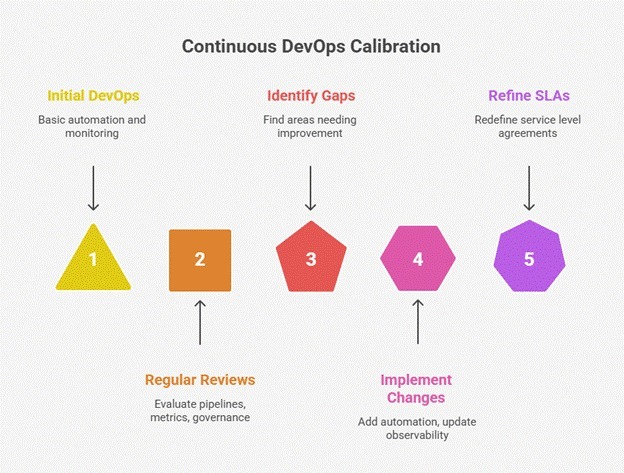
5. Continuously Evolve the Process
DevOps is a set of practices and, as a result, it requires continuous adaptation.
Pipelines, metrics, and governance frameworks need regular reviews to reflect how your systems and teams grow. What worked last quarter might not fit new workloads, architectures, or compliance demands.
Teams that treat DevOps as a living system outperform those that see it as a checklist. The mindset should always be learning, adjusting, and refining.
Whether that means adding new automation, updating observability patterns, or redefining SLAs, the key is to keep improving step by step. Constant iteration keeps your cloud operations predictable, efficient, and aligned with business outcomes.
NOVA’s Role in Cloud Strategy Optimization
NOVA helps you connect automation, observability, and scalability into one consistent operating model.
We already told you we are certified AWS Advanced Partners and Datadog Gold Partners. Well, we combine that certified expertise with nearshore engineering teams that work in real time with your developers. The result is faster collaboration, full-stack visibility, and measurable improvements across infrastructure, applications, and APIs.
Our teams focus on observability-driven DevOps to give you clear visibility across every layer of your stack and prevent costly blind spots. Our teams will tune Datadog environments, automate scaling decisions, and embed compliance into delivery pipelines.
All this will lead to cost management and performance at scale.
Besides, NOVA’s impact is best seen in real outcomes.
- For Alpiq, NOVA’s Datadog Mule® Integration replaced five separate monitoring tools with a unified system. This helped Alpiq reduce mean-time-to-detect (MTTD) by up to 30% and improve visibility across MuleSoft APIs.
- For Brightfield, NOVA migrated workloads from Oracle to AWS microservices. This helped Brightfield cut annual licensing costs and achieve zero-downtime releases.
Each of our case studies shows the same result: DevOps done right turns cloud strategy into a measurable, predictable advantage.
Transform Your Cloud Strategy with NOVA
Cloud ROI doesn’t come from tools alone. It comes when DevOps becomes a built-in part of your strategy. This means connecting automation, observability, and governance into one reliable system.
Without DevOps, you face inefficiency, wasted spend, and operational risk. With it, you gain speed, resilience, and cost control. The difference lies in how your teams build, release, and recover.
Want to optimize your cloud strategy through AWS and DevOps best practices that turn complexity into measurable, predictable performance? Get in touch with us today!
FAQ
How does DevOps improve cloud cost efficiency?
DevOps improves cost efficiency by automating scaling, optimizing workloads, and reducing idle infrastructure. With better monitoring and automated rollbacks, you prevent waste and only pay for what delivers value.
What’s the difference between DevOps and CloudOps?
DevOps focuses on automating software delivery and improving collaboration across development and operations. CloudOps manages the performance, cost, and availability of cloud environments. Also, DevOps gives you the process discipline, while CloudOps keeps it running smoothly.
Which AWS tools support DevOps best practices?
AWS tools like CodePipeline, CodeBuild, and CloudFormation support automation, version control, and reliable deployments. They let you standardize environments, reduce manual errors, and shorten release cycles.
How can Datadog improve cloud observability?
Datadog unifies metrics, logs, and traces across your infrastructure, applications, and APIs. This full-stack visibility helps you detect issues early and reduce mean time to recovery (MTTR).
How do I measure ROI from DevOps in my cloud strategy?
You measure ROI by tracking reduced downtime, faster deployment frequency, and lower incident recovery costs. Over time, these metrics show how DevOps translates into predictable performance and measurable financial gains.
Comments